On the final night of the Champions League’s first league phase in January 2025, all 18 matches kicked off at the same time and the table changed almost every minute. Manchester City needed a win against Club Brugge to avoid going out and came from a goal down to get it. Clubs dropped in and out of the top eight while players checked the scoreboard. UEFA had spent years being told its new format was too complicated. That night most fans stopped complaining.
The 2026/27 season is the third under the system, which replaced the group stage that had run since the early 1990s.
Who qualifies
Thirty-six clubs play in the league phase. Most qualify by finishing high in their domestic league the previous season. How many places a country gets depends on UEFA’s coefficient rankings, which measure how well its clubs have done in Europe over five years. England, Spain, Germany and Italy normally get four places each, France three, and smaller leagues fewer.
On top of that, two “European Performance Spots” go to the two countries whose clubs did best in Europe the previous season. England used one to send a fifth club in 2025/26, and the extra places have become a race of their own, with fans of mid-table clubs cheering on their rivals in Europe.
The holders of the Champions League and the Europa League qualify automatically. The remaining places are decided by qualifying rounds in the summer, mostly for champions of smaller leagues.
One table, eight games
All 36 clubs go into a single league table. Each plays eight matches, four at home and four away, against eight different opponents. Nobody plays everyone, so there are no return fixtures.
Opponents are drawn from four pots of nine, sorted by club coefficient, with the holders at the top of Pot 1. Every club plays two teams from each pot, one at home and one away. Clubs cannot face teams from their own country, and can play no more than two from any single other country. Software makes the draw, because working out a valid set of fixtures for 36 clubs by hand would take all night.
A win is worth three points and a draw one. Clubs level on points are separated by goal difference, then goals scored, then away goals scored, then wins, then away wins, followed by the combined points and goal difference of the opponents they faced.
The league phase runs from September to the end of January. For 2026/27 it started on September 8 and ends on January 27, 2027. As in every season of the format, all 18 games in the final round kick off at the same time.
Who goes through
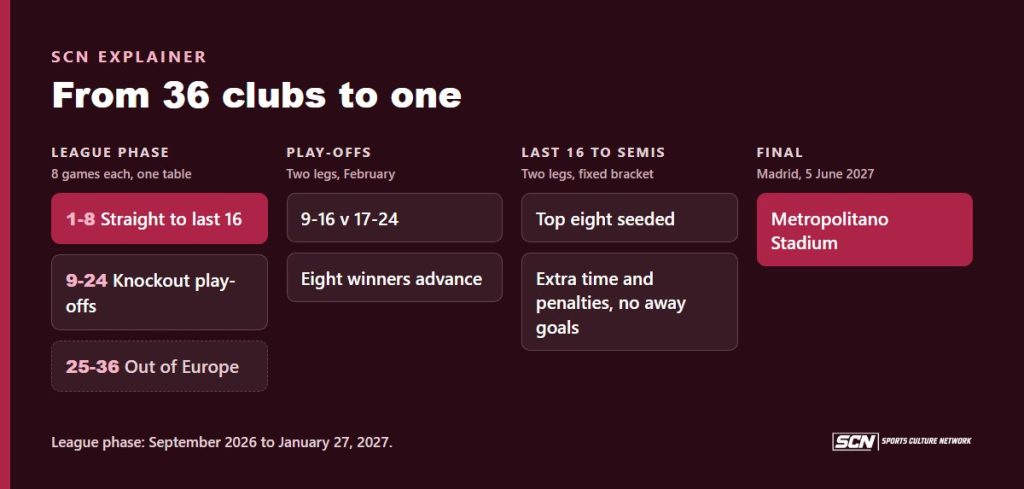
The top eight go straight into the round of 16. Clubs in ninth to 24th enter a knockout play-off round in February. Clubs finishing 25th or lower are out of Europe for the season. Unlike the old group stage, nobody drops into the Europa League.
In the play-offs, the teams from ninth to 16th are seeded and play the teams from 17th to 24th over two legs, with the seeded team at home in the second leg. Pairings follow league positions: ninth and tenth face the clubs from 23rd and 24th, 11th and 12th face 21st and 22nd, and so on, with a draw deciding the exact pairings within each pair.
Finishing in the top eight is worth a lot. It means two fewer matches in a packed schedule, a seeded place in the round of 16 and home advantage in the second leg of every knockout tie until the final.
The knockout rounds
The round of 16, quarter-finals and semi-finals are two-legged. Away goals were scrapped in 2021, so a tie level on aggregate after 180 minutes goes to 30 minutes of extra time and then penalties.
The bracket is set in advance by league position. Clubs that finish first and second know they will be in opposite halves and cannot meet until the final if they keep winning. The same applies to third and fourth, and so on down the table. That gives the top clubs another reason to keep pushing in the last round of the league phase.
The final is a single match at a neutral stadium chosen years ahead. The 2027 final is at the Metropolitano in Madrid, home of Atlético, on June 5. The stadium also hosted the 2019 final, in which Liverpool beat Tottenham.
Why UEFA changed it
The old format, eight groups of four, had a predictable rhythm. The biggest clubs often qualified with two games to spare, and the dead rubbers that followed bored fans and broadcasters alike. UEFA also wanted more matches between big clubs earlier in the season, partly to see off the threat of a breakaway European Super League backed by several of the richest clubs in 2021.
The new system gives each club two more games than the old group stage, and a lot more of them between leading teams. It also brings in more money, which is shared out partly by results and partly by a ranking that rewards a club’s history in Europe.
The criticism has not gone away. Players and their unions argue the extra fixtures add to a calendar already overloaded by the expanded Club World Cup and international football. Some fans of smaller clubs say the table makes it harder to follow their team’s chances. But the number of meaningful games in the last round has silenced many of the doubters.
The kings of Europe
Real Madrid have won the European Cup and Champions League 15 times, more than twice as many as the next most successful club, AC Milan with seven. Paris Saint-Germain finally won their first title in 2025, beating Inter 5-0 in Munich, the biggest winning margin in a final. Under the new format, that is the target for every club in the draw: eight games, then up to four knockout rounds, then a single night in May or June.
Follow every round in our football coverage, browse squads and stats for Europe’s leading clubs, and look up any player in our player database.