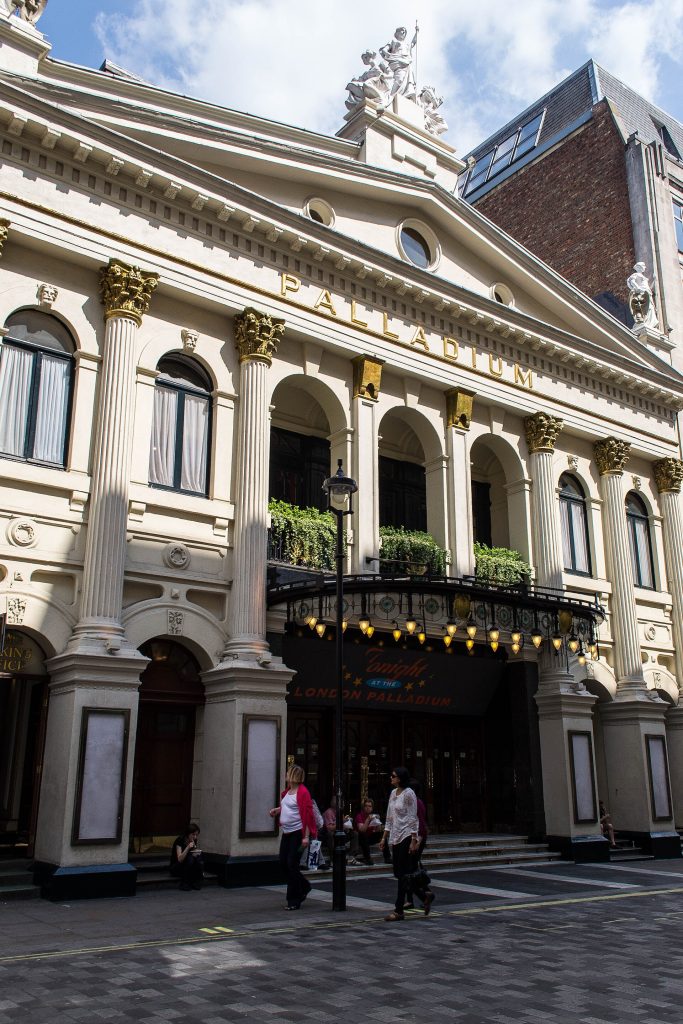
When Harry Kane walked onto the stage at the London Palladium on October 26, 2026, he became the first Englishman to win the Ballon d’Or since Michael Owen in 2001. It was the first time the ceremony had been held in London, chosen as a tribute to Stanley Matthews, who won the very first award 70 years earlier. Kane had scored 61 goals for Bayern Munich in a season that ended with the German league and cup Double. As always, not everyone agreed with the result. That is part of the Ballon d’Or too.
Where it started
The French magazine France Football created the Ballon d’Or, the golden ball, in 1956, with the help of its editor Gabriel Hanot, one of the founders of the European Cup. Journalists voted for the best player in Europe, and Matthews, then 41 and playing for Blackpool, won. For almost four decades only European players at European clubs were eligible, which is why Pelé and Diego Maradona never won it during their careers. The rules opened to non-Europeans at European clubs in 1995, when George Weah of Liberia won, and to players anywhere in the world in 2007.
Between 2010 and 2015 the award was merged with FIFA’s World Player of the Year to form the FIFA Ballon d’Or, with votes from national team captains and coaches as well as journalists. The partnership ended in 2016, and France Football went back to a jury of journalists. Since 2024, the award has been organised in partnership with UEFA.
Who votes
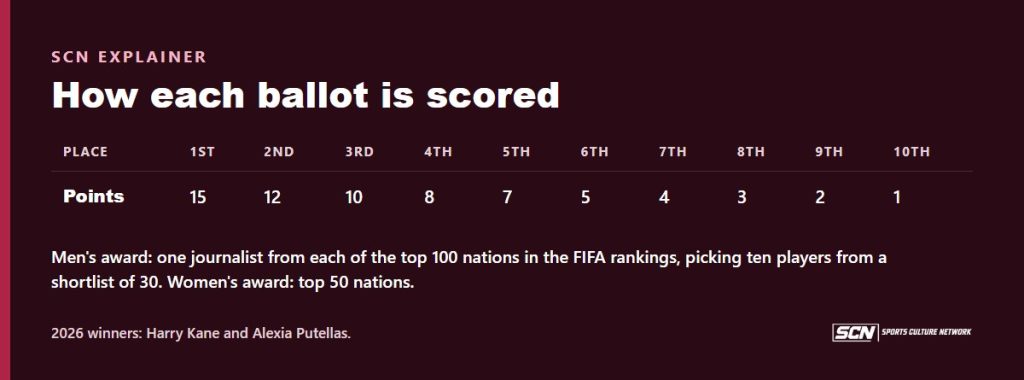
The men’s award is decided by a panel of journalists, one from each of the top 100 countries in FIFA’s men’s world rankings. The women’s award uses one journalist from each of the top 50 countries in the women’s rankings. Each voter lists their top ten players from a shortlist of 30 announced in the late summer.
Points are awarded by position: 15 for first place, 12 for second, 10 for third, then 8, 7, 5, 4, 3, 2 and 1. The player with the most points wins.
The criteria
Voters are asked to consider three things, in order of importance:
- individual performances and decisive and impressive character;
- team performances and achievements;
- class and fair play.
The criteria leave a lot of room for interpretation, which is why debates over the winner rarely end. A player with record goal totals for a club that won nothing can lose to one who won the Champions League or the World Cup with fewer goals. In World Cup years, a strong tournament has often decided the vote.
From calendar year to season
For most of its history the award covered a calendar year, January to December, which split each football season in half. From 2022 it moved to cover a single season, from August to July. That made the award easier to judge, with major tournaments in the summer counted alongside the club season that had just finished, and it moved the ceremony from December to the autumn.
The other awards
The ceremony now includes several other prizes. The women’s Ballon d’Or has been awarded since 2018, when Ada Hegerberg won the first. The Kopa Trophy, for the best player under 21, and the Yashin Trophy, for the best goalkeeper, were added in 2018 and 2019. The Gerd Müller Trophy goes to the top scorer of the season, and there are awards for the coach and club of the year. Women’s versions of most of these have been added since.
In 2026, Alexia Putellas won her third women’s Ballon d’Or, Spain’s Unai Simón won the Yashin Trophy and Luis de la Fuente, who led Spain to the World Cup, was named coach of the year.
The record holders
Lionel Messi has won the men’s award eight times, in 2009, 2010, 2011, 2012, 2015, 2019, 2021 and 2023, a record that is unlikely ever to be matched. Cristiano Ronaldo won five, in 2008, 2013, 2014, 2016 and 2017. Between them they won every award from 2008 to 2017, until Luka Modrić broke the run in 2018.
Before them, Michel Platini won three in a row from 1983 to 1985, and Johan Cruyff and Marco van Basten also won three each. Recent winners include Karim Benzema in 2022, Rodri in 2024, the first Spanish-born winner since Luisito Suárez in 1960, Ousmane Dembélé in 2025 after Paris Saint-Germain’s first Champions League title, and Kane in 2026.
The award was cancelled in 2020 because of the pandemic, which still annoys supporters of Robert Lewandowski, who many believed would have won after Bayern’s treble that year.
Controversy
Few years pass without an argument. In 2010, Wesley Sneijder won the Champions League and reached the World Cup final but finished outside the top three. In 2019, Virgil van Dijk lost narrowly to Messi after Liverpool won the Champions League. In 2024, Real Madrid boycotted the ceremony when it became clear that Vinícius Júnior had not won. The voting system, the criteria and the shortlist have all been changed over the years, and none of those changes has stopped the debate. The award still matters to the players, and the arguments still make it one of football’s most talked-about nights.
Follow the stars in our football coverage and look up their records in our player database, including Harry Kane’s profile.