The richest game in football is not a final. It is the Championship play-off final at Wembley each May, where two clubs from England’s second tier play for the last place in the Premier League. The winner’s reward, counting television money and the payments that protect clubs if they go straight back down, has been put at well over £200 million. The loser goes back to the Championship.
That game only exists because of promotion and relegation, the system that ties almost every football league in Europe into a pyramid. For American fans used to closed leagues, it is the biggest structural difference between European football and the NFL, NBA or MLS.
The basic idea
Each season, the teams that finish at the bottom of a division drop into the one below. They are relegated. The teams at the top of the lower division replace them. They are promoted. Membership of a league depends on results, not on owning a franchise, so in theory a club from a small town can climb from amateur football to the top flight. A few have done it. AFC Bournemouth were close to going out of business in the fourth tier in 2008 and reached the Premier League in 2015.
England
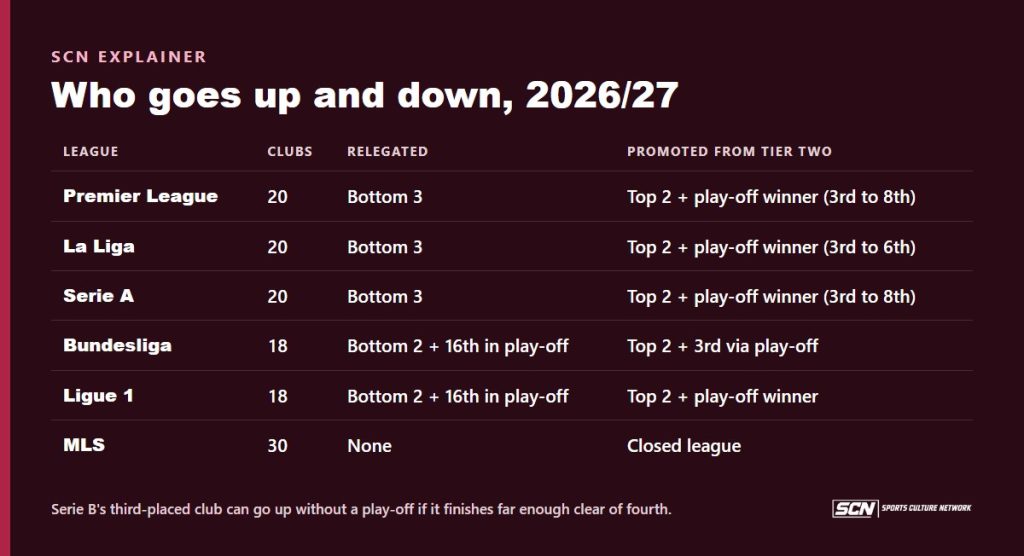
The Premier League has 20 clubs and relegates three each season. The bottom three go down to the Championship, the second tier, whatever their points total. If two clubs finish level on points, goal difference separates them, then goals scored.
Three teams come up. The top two in the Championship are promoted automatically. The third place goes to the winner of the play-offs, which change from the 2026/27 season. Instead of four clubs, six now take part, from third to eighth. The clubs in fifth to eighth play single-leg eliminators, with fifth and sixth at home. The winners face third and fourth in two-legged semi-finals, and the final is at Wembley.
The same up-and-down system runs through League One and League Two, the third and fourth tiers, and on into the National League and below. The pyramid has more than a dozen levels, and in principle every club in it can rise to the top.
Spain, Italy, Germany and France
La Liga has 20 clubs and relegates three to the Segunda División. The top two in the Segunda go up automatically and a play-off between the teams in third to sixth decides the third place.
Serie A is the same size and also relegates three. Serie B sends up its top two, plus the winner of a play-off involving the teams from third to eighth. If the third-placed team finishes far enough clear of fourth, it goes up without a play-off.
The Bundesliga has 18 clubs. The bottom two go straight down to the 2. Bundesliga, and the team in 16th plays the third-placed 2. Bundesliga club over two legs to decide who plays in the top flight the next season. The relegation play-off, the Relegation in German, is one of the most dramatic fixtures of the German season. Hamburg, who had never been relegated in their history, survived it twice before finally going down in 2018. They came back up in 2025.
Ligue 1 was cut from 20 clubs to 18 in 2023. Two go down automatically, and the club in 16th plays the winner of a Ligue 2 play-off for a place in the top division.
What relegation costs
Going down means much less television money, smaller crowds and lower sponsorship, and for players it can mean a pay cut. Most top-flight contracts include relegation clauses that reduce wages by a set percentage, often between a quarter and a half.
In England the Premier League softens the blow with parachute payments, a share of TV revenue paid to relegated clubs for up to three seasons (two for clubs that only spent one season in the top flight). They help relegated clubs avoid financial collapse. Critics say they also distort the Championship, because clubs with parachute money can outspend the rest of the division and bounce straight back. In recent seasons several newly promoted clubs have gone straight back down, then come straight back up, creating a group of clubs that sit between the two divisions.
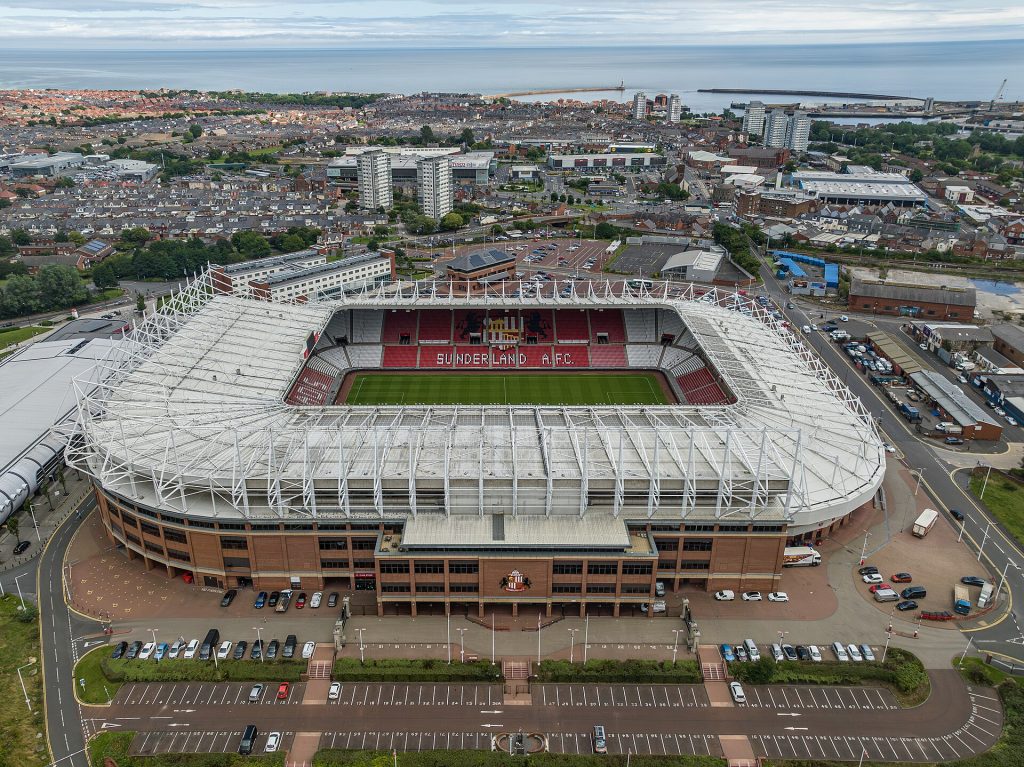
The fall can be steep. Sunderland went from the Premier League to League One in successive seasons between 2017 and 2018, and spent four years in the third tier before returning to the top flight in 2025. Parma, one of Serie A’s strongest sides in the 1990s and twice winners of the UEFA Cup, went bankrupt in 2015 and were restarted in Serie D.
Games that would not otherwise matter
Promotion and relegation give meaning to games that would otherwise not matter. In a closed league, a team out of the playoff race by February has little to play for, and may even benefit from losing because of the draft. In Europe, the bottom of the table is often more dramatic than the top. A last-day relegation battle can involve half a dozen clubs, all checking scores elsewhere on their phones in the stands.
It also explains some of the way European clubs are run. Managers at struggling clubs are sacked quickly because the cost of relegation is so high. Clubs that come up spend heavily in their first summer to try to stay up, and many fail.
Why MLS does not do it
Major League Soccer is a closed league in the American mould. Its owners paid large fees to join, and relegation would put that investment at risk, so there is none. Teams that finish last stay in the league and get better draft picks instead. Below MLS, the USL runs its own divisions and has announced plans to introduce promotion and relegation between its own leagues, but there is no route from those leagues into MLS. It remains one of the most argued-about issues in American soccer.
Follow the title races and relegation fights in our football coverage, look up any of the 60 clubs in our database, and read how the Champions League works to see what a team at the other end of the table is playing for.