On the final day of the 2025 summer window, Liverpool agreed to pay Newcastle a British record fee of around £125 million for Alexander Isak, after a summer-long standoff in which the striker refused to play for his club. The deal went through on deadline day, the last hours before the window shut. For football fans in England, deadline day is a holiday of rumour, reporters outside training grounds and late-night announcements. It exists because of a set of rules most fans only half understand.
What a transfer window is
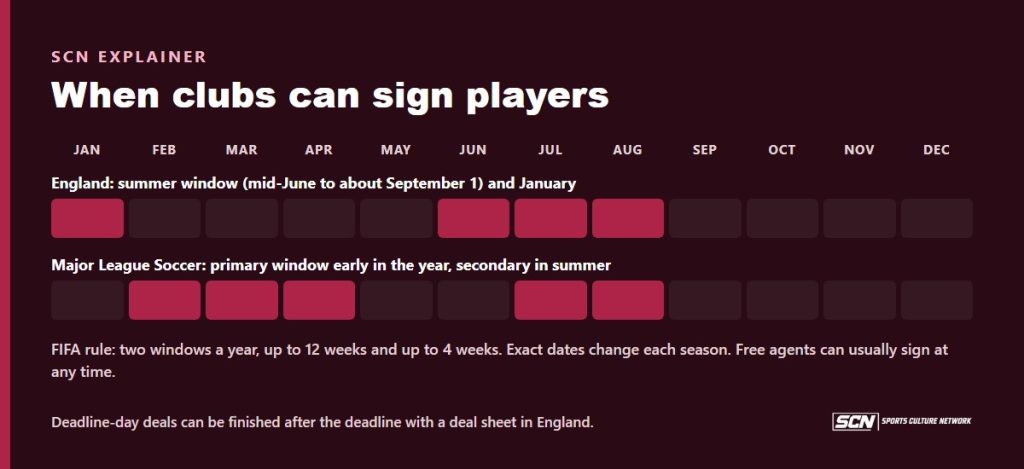
A footballer can only be registered to play for a new club during set periods, known as registration periods or transfer windows. FIFA’s rules allow each national association two windows a year: one of up to 12 weeks in the off-season and one of up to four weeks in the middle of the season. Each country picks its own dates within those limits.

In England, the summer window usually opens in mid-June and closes on or around September 1. The winter window runs through January. Other European leagues use similar dates, though some close a few days later. Major League Soccer, whose season runs from February to December, has a primary window early in the year and a secondary window in the summer.
Outside the windows, clubs can still agree deals in principle. They just cannot register the player until the window opens. The main exception is free agents, players whose contracts have ended, who can be signed at any time in most leagues.
The windows were introduced across Europe in 2002, partly to calm the European Commission’s concerns about players moving freely, and partly to stop squads changing constantly during a season. Before that, clubs in many countries could buy players until late in the season.
How a transfer works
A transfer happens when one club pays another to end a player’s contract early so he can sign for the buyer. The selling club has to agree a fee, and the player has to agree personal terms with the buying club: salary, length of contract, bonuses and image rights. Then comes a medical examination, the paperwork and registration with the league and national association.
Fees are rarely paid in one go. They are spread over the length of the player’s new contract, often with add-ons: extra payments if the player makes a certain number of appearances, if the club wins the league or qualifies for the Champions League, or if he plays for his country. That is why reported fees often come with two numbers, such as “£100 million, rising to £115 million”.
Selling clubs often include a sell-on clause, a percentage of any future fee if the player is sold again. Smaller clubs that develop young players rely on these. Clubs that sell a player they trained between the ages of 12 and 23 also receive a share of the fee through FIFA’s solidarity payments, so a transfer of a big star can send money to his first youth club years later.
Release clauses
In Spain every player’s contract must include a release clause, a fixed fee that, if paid in full, lets the player leave regardless of what his club wants. Clauses for big stars are set deliberately high, often at a billion euros. When Paris Saint-Germain paid Neymar’s €222 million release clause in 2017, it set a world record that more than doubled the previous one. Release clauses are optional in other countries but common in player contracts across Europe, particularly as a way for smaller clubs to attract players who want a route to a bigger club.
Loans
A loan moves a player to another club for a fixed period, usually a season, while he stays under contract with his parent club. Loans help young players get first-team experience and let clubs move on players they do not want without selling them. Some include an option or an obligation to buy at the end, which is often how clubs spread the cost of a transfer across two financial years.
FIFA limits how many international loans a club can make. Since 2024 each club can loan out and take in no more than six senior players at any one time, a rule designed to stop the biggest clubs stockpiling young players and lending them all over Europe.
Free agents and the Bosman ruling
Until 1995, clubs could demand a fee even for players whose contracts had expired. That changed when a Belgian midfielder, Jean-Marc Bosman, won a case at the European Court of Justice, which ruled that players in the European Union could move freely at the end of their contracts. The Bosman ruling transformed football. It gave players far more power, increased wages and created the modern practice of letting a contract run down and leaving for nothing.
That is why clubs are so keen to sell players in the final year of their contracts. A player with 12 months left can be bought at a discount. Wait another year and he leaves for free. Players with six months left can also sign a pre-contract agreement with a club in another country.
Financial rules
Clubs cannot simply spend what they like. UEFA’s squad cost rules limit what clubs in its competitions can spend on wages, transfers and agents’ fees as a proportion of their revenue, and domestic leagues have their own versions. In England, the Premier League’s financial rules led to points deductions for Everton and Nottingham Forest in recent seasons. That is why many clubs rush to sell players before the end of June, when the financial year closes, and why “pure profit” academy sales are so valuable: they count fully as income in the year they happen.
Why deadline day happens
Deadline day exists because every club waits. Buyers hope prices fall as time runs out, sellers hope desperate clubs pay more, and every sale sets off a chain reaction of replacements. A club that sells its striker on the last morning has hours to find a new one. Paperwork is the final hurdle. The Premier League allows clubs to submit a “deal sheet” before the deadline to show a transfer is close, giving them extra time to finish the documents. Several high-profile deals have still collapsed because forms arrived seconds too late.
For fans, it is part of the season. For players, it can mean moving cities in a day. And for agents, who take a share of many transfers, it is the most profitable night of the year.
Follow every signing and rumour in our football coverage, check squads in our clubs directory, and look up any player in our player database.