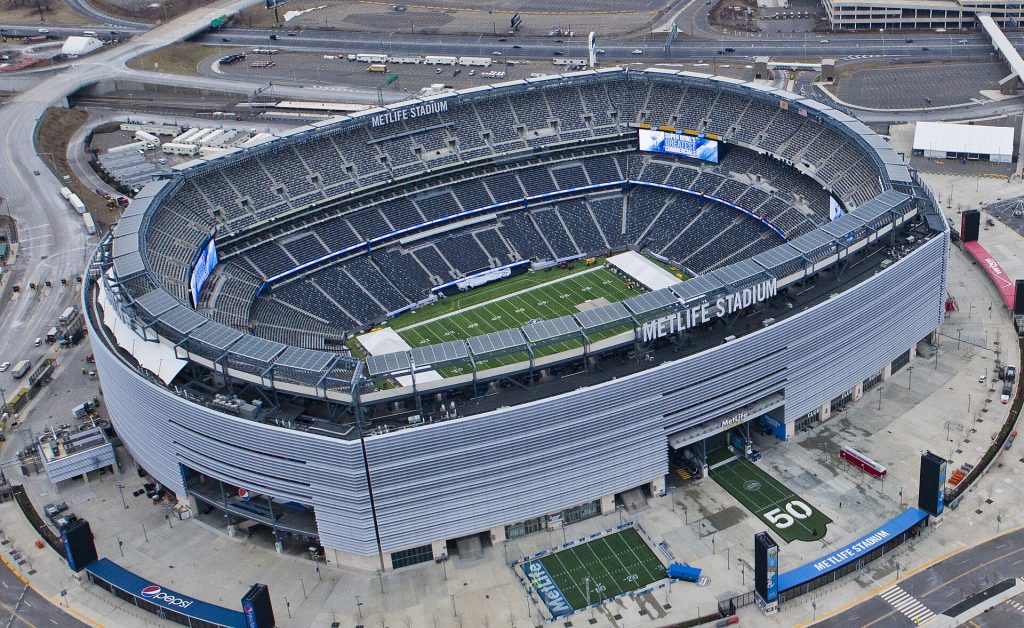
On July 19, 2026, at MetLife Stadium in New Jersey, Ferran Torres scored in the 106th minute to give Spain a 1-0 win over Argentina and their second World Cup. Lionel Messi, at what was widely expected to be his last World Cup, finished with the Silver Ball. Kylian Mbappé won the Golden Boot again, with ten goals, the most at one World Cup since Gerd Müller in 1970. It was the end of the biggest World Cup ever staged: 48 teams, 16 host cities in three countries and 104 matches over 39 days. That is the format the tournament now keeps.
From 13 teams to 48
The first World Cup, in Uruguay in 1930, had 13 teams, all invited. The field grew to 16 in 1934, 24 in 1982 and 32 in 1998, and the 32-team format, eight groups of four, lasted through 2022 in Qatar. In 2017 FIFA voted to expand to 48 from 2026, saying it wanted to give more countries a chance to play at the finals. The decision meant more qualifying places for Africa, Asia and North and Central America, and more matches to sell to broadcasters.
Qualifying
Every FIFA member except the hosts plays qualifiers through its continental confederation. The places are shared out in advance. For 2026 the split was:
- Europe (UEFA): 16 places
- Africa (CAF): 9
- Asia (AFC): 8
- South America (CONMEBOL): 6
- North and Central America and the Caribbean (CONCACAF): 6, including the three hosts
- Oceania (OFC): 1
- Intercontinental play-off: the last 2 places, contested by six teams from different confederations
Qualifying formats vary. South America plays a single league in which all ten nations meet home and away over two years. Europe uses groups followed by play-offs. Africa, Asia and CONCACAF use several rounds of groups. Hosts qualify automatically, which is how the United States, Canada and Mexico all reached 2026 without playing a qualifier.
The expansion opened the door to first-time qualifiers. Cape Verde, Curaçao, Jordan and Uzbekistan all reached the finals for the first time in 2026.
The group stage
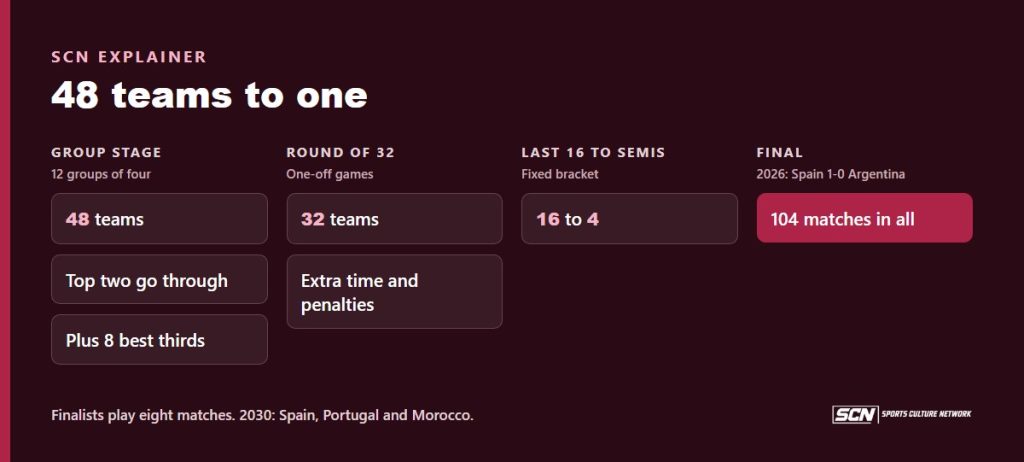
The 48 teams are drawn into 12 groups of four. Teams are seeded into pots by FIFA ranking, with the hosts in the top pot, and the draw keeps teams from the same confederation apart, except for Europe, whose 16 teams have to share groups.
Each team plays the other three once. A win is worth three points, a draw one. The top two in each group go through, along with the eight best third-placed teams out of twelve, making 32 teams for the knockouts. Ties on points are broken by results between the teams involved, then by goal difference, goals scored and finally by fair play points and FIFA ranking.
The best-third-place rule was the most criticised part of the new format before it began. A team can go through with three points from three games, and some teams go into their final group game knowing a draw will do. FIFA’s original plan, 16 groups of three, was dropped after concerns that the final group games could be fixed. Four-team groups with simultaneous final matches were thought to be safer.
The knockouts
From the round of 32 onward, every game is a one-off. If the score is level after 90 minutes, there are 30 minutes of extra time and then a penalty shoot-out. The bracket is set in advance, so teams know from the draw who they would face if they win their group or finish second, and that can give a team a reason to prefer one finishing position over another.
The round of 32 is followed by the round of 16, quarter-finals, semi-finals, a third-place play-off and the final. A team that goes all the way plays eight matches, one more than under the old format. The 2026 tournament ran from June 11 in Mexico City to July 19 in New Jersey.
How 2026 went
The opening match was played at the Estadio Azteca, which became the first stadium to host games at three World Cups. Matches were spread across eleven American cities, three in Mexico and two in Canada, and travel distances were a constant talking point, as were the summer heat and ticket prices.
Spain, the European champions, conceded only once in the whole tournament. In the final, Argentina’s Enzo Fernández was sent off in stoppage time at the end of normal time, and Torres scored the winner in extra time. Rodri won the Golden Ball as the tournament’s best player, Unai Simón the Golden Glove for the best goalkeeper and Pau Cubarsí the award for the best young player, a clean sweep for Spain. Mbappé became the first player to win the Golden Boot at two straight World Cups.
Who has won it
Only eight countries have won the World Cup. Brazil lead with five titles, followed by Germany and Italy with four each, Argentina with three, France and Uruguay with two each, Spain now with two, and England with one, from 1966. No team from outside Europe or South America has ever reached a final.
What comes next
The 2030 World Cup will be shared by Spain, Portugal and Morocco, with three opening matches in Uruguay, Argentina and Paraguay to mark the tournament’s centenary. It will be the first World Cup held on three continents. In 2034 the tournament goes to Saudi Arabia, a decision that drew criticism from human rights groups and raised the prospect of another winter World Cup, as in Qatar in 2022.
There has also been talk of expanding the field again, to 64 teams for 2030. FIFA has not adopted it, and many confederations oppose it. For now, 48 teams and 104 matches is the World Cup.
Follow international football in our football coverage, look up any of the players in our player database, and read how the Club World Cup works.