Every football fan has had the conversation. Someone new to the game asks what offside is, and a confident explanation about “being behind the last defender” falls apart at the first follow-up question. The law itself, Law 11 in the rulebook kept by the International Football Association Board (IFAB), runs to barely a page. The arguments about it fill whole seasons.
Position first
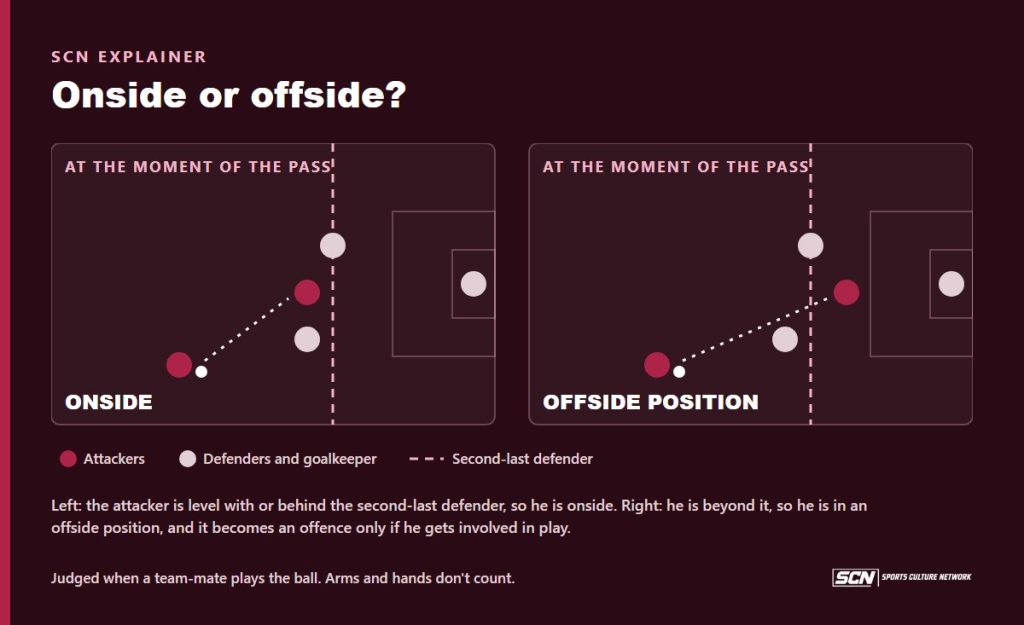
A player is in an offside position if, at the moment a team-mate plays or touches the ball, any part of his head, body or feet is in the opponents’ half and closer to their goal line than both the ball and the second-last opponent.

The second-last opponent is usually the last outfield defender, because the goalkeeper is normally the last. If the goalkeeper has come out, the second-last opponent might be a defender on the goal line. The test uses the second-last opponent either way.
Arms and hands do not count. A striker whose arm is beyond the defender but whose shoulder is level is onside, and the top of the arm, roughly in line with the bottom of the armpit, is the cut-off. Level is onside. A player cannot be offside in his own half, and cannot be offside if he is behind the ball when it is played.
Then involvement
This is the part most people forget. Standing in an offside position is not an offence. A player is only penalised if he becomes involved in active play, which the law describes in three ways.
The obvious one is interfering with play: playing or touching a ball passed or touched by a team-mate. The second is interfering with an opponent, which covers blocking a goalkeeper’s line of sight, challenging for the ball, clearly trying to play a ball close to him, or making an obvious action that affects an opponent’s ability to play it. The third is gaining an advantage by playing a ball that rebounds or deflects to him off the post, the crossbar, an opponent or the referee after he was already in an offside position.
A forward standing in an offside position on the far side of the pitch while a team-mate scores from the edge of the box has done nothing wrong. Move him in front of the goalkeeper, blocking his view, and the goal is ruled out.
When it is judged
Offside position is judged at the moment the ball is played by a team-mate, not when the receiving player gets it. A striker can sprint ten yards past the defence after the pass and still be onside. That is the moment the lines on television freeze, and why a referee’s assistant has to watch two places at once: the passer’s foot and the line of defenders.
The exceptions
There is no offside offence if a player receives the ball directly from a throw-in, a goal kick or a corner kick. Teams use all three, most obviously long throws into a crowded box, where attackers can stand anywhere.
The trickier exception involves defenders. If an opponent deliberately plays the ball, an attacker in an offside position who then receives it is not offside, unless the defender’s touch was a deliberate save. A miscued clearance or a stretched attempt to intercept a pass counts as a deliberate play. A deflection off a defender who was not trying to play the ball does not, and neither does a save, even an outfield player’s block on the line.
The IFAB clarified this in 2022 after a run of controversial calls. Referees now consider whether the defender had time to see the ball and control his movement, and whether he was trying to play it. The line between a deliberate play and a reflex deflection is still where the most heated arguments start.
What happens next
When an offside offence is given, the defending team gets an indirect free kick from where the offence happened, which can be in the attacker’s own half if that is where he became involved. No card is shown for offside alone.
The assistant’s flag
Assistant referees run the line level with the second-last defender for the whole game. Since VAR arrived, they have been told to keep the flag down on tight calls where a goal might follow and let play finish. If the assistant flags straight away and the call is wrong, a goal that should have stood can never be scored. If he waits and a goal goes in, VAR can still check it.
That is why fans see attacks run on, a goal scored and a flag go up afterwards. It looks odd but it gets more calls right.
VAR and semi-automated offside
Video assistant referees check every goal for offside. In the first years of VAR, officials froze the broadcast at the moment of the pass, picked the point of each player’s body by eye and drew lines across the screen. Calls decided by a toenail or an armpit, sometimes after several minutes, made VAR offsides deeply unpopular, especially in England.
Semi-automated offside technology (SAOT) speeds that up. Cameras under the stadium roof track up to 29 points on each player’s body many times a second, and a sensor in the ball, or ball-tracking from the cameras, marks the exact moment it is kicked. The system alerts the video officials and produces a 3D graphic for broadcasters. It was used at the 2022 World Cup and in the Champions League, and the Premier League switched it on in April 2025. In 2026 the IFAB wrote it into the Laws of the Game as a technology competitions can choose to use.
The “semi” matters. Software calculates the positions, but a human still decides whether an attacker in an offside position was involved in play, and whether a defender’s touch was deliberate.
The Wenger idea
Arsène Wenger, now FIFA’s head of global football development, has argued for years that an attacker should be onside unless there is clear daylight between him and the defender. In other words, any part of the body that scores level should keep him onside. The Canadian Premier League trialled a version of it in 2026. Fewer offsides were given and more goals were scored, but in October 2026 the IFAB’s technical panels showed little enthusiasm for taking it further. For 2026/27, Law 11 is unchanged.
Why the law exists
Football without offside would be a game of goal-hanging, with strikers parked next to the goalkeeper waiting for long balls. The law, in one form or another, dates back to the earliest codified rules in the 1860s, when a player had to stay behind the ball altogether. The modern two-player version dates to 1925, and the change produced an immediate burst of goals. Nearly every change since has been made to favour the attacker, and the arguments about where the line should fall show no sign of ending.
Follow every result and VAR controversy in our football coverage, browse every club we cover, and read how promotion and relegation work.