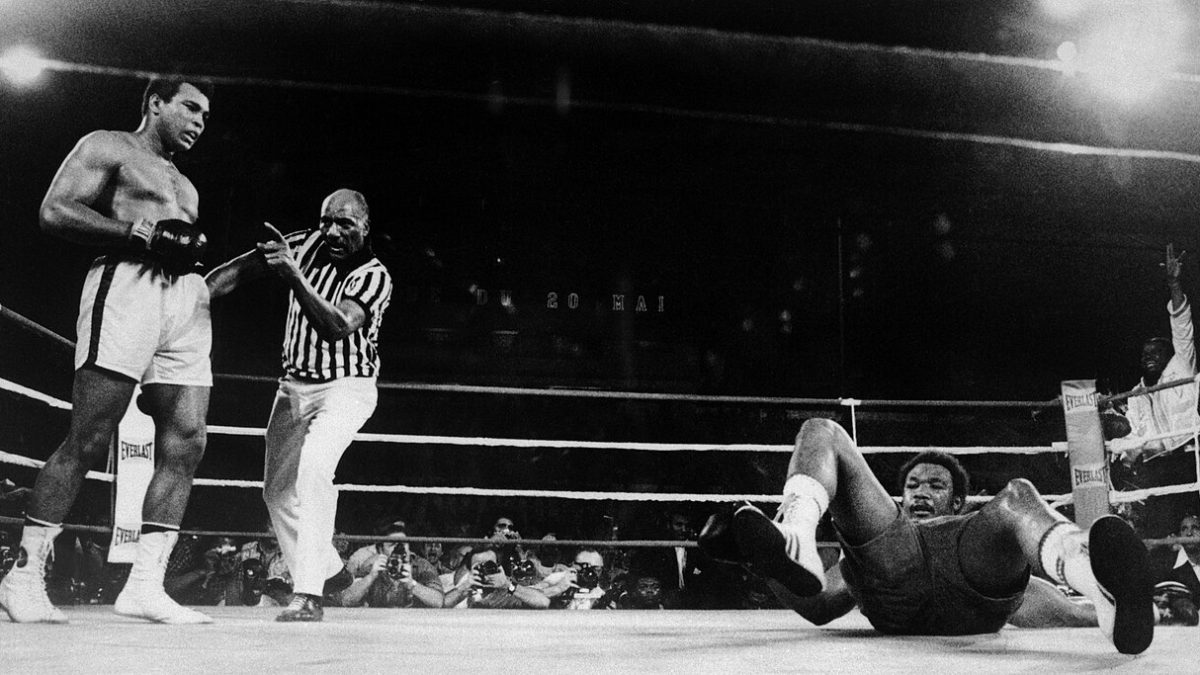
George Foreman arrived in Kinshasa with a 40-0 record and 37 knockouts. He had flattened Joe Frazier and Ken Norton, the two men who had beaten Muhammad Ali, and neither had lasted beyond the second round. Frazier went down six times. Ali was 32, seven years removed from the night his title was stripped for refusing the Vietnam draft, and the betting made him a 4-1 underdog. In the early hours of 30 October 1974, he knocked Foreman out in the eighth round.
The fight is remembered for the tactic that won it. The business behind it was just as strange, with a young promoter, a dictator and a record purse all meeting in the middle of Africa.
The deal that took boxing to Zaire
Don King, then building his name as a promoter, secured both fighters by promising each about $5 million, a sum nobody in boxing had been paid for a single night. Accounts of the total vary, with some reports describing a $10 million purse. King did not have the money. It came from Mobutu Sese Seko, the president of Zaire, now the Democratic Republic of Congo, who wanted the world’s attention on his country and was prepared to pay for it.
King’s first slogan for the event was “From Slaveship to Championship”. Mobutu rejected it. The name that lasted came from Ali, who had been calling it the Rumble in the Jungle during training.
The bout was first set for 25 September. Eight days before that date, an accidental elbow from sparring partner Bill McMurray opened a cut above Foreman’s eye that needed 11 stitches, and the fight moved back five weeks. Both men stayed in Zaire through the delay, and that time mattered. Ali toured the country, talked to anyone who would listen and won the public completely. Crowds took up the chant “Ali, boma ye”, Lingala for “Ali, kill him”. Foreman, reserved and often seen with his German shepherd, never found the same welcome.
Eight rounds at the Stade du 20 Mai
The opening bell rang around 4 a.m. local time so the fight could reach American closed-circuit audiences in the evening. Ali surprised Foreman in the first round by leading with right hands, a risky punch against a fighter of that size. Then, from the second round on, he did something his own corner found alarming. He backed onto the ropes, covered up and let the champion swing.
Foreman threw enormous punches at Ali’s arms and body, and Ali answered by leaning back, clinching behind the neck and talking into his ear. The ropes absorbed part of the force. Round after round the younger man spent his strength. Ali later gave the method a name, the rope-a-dope, and it has been attached to him ever since.
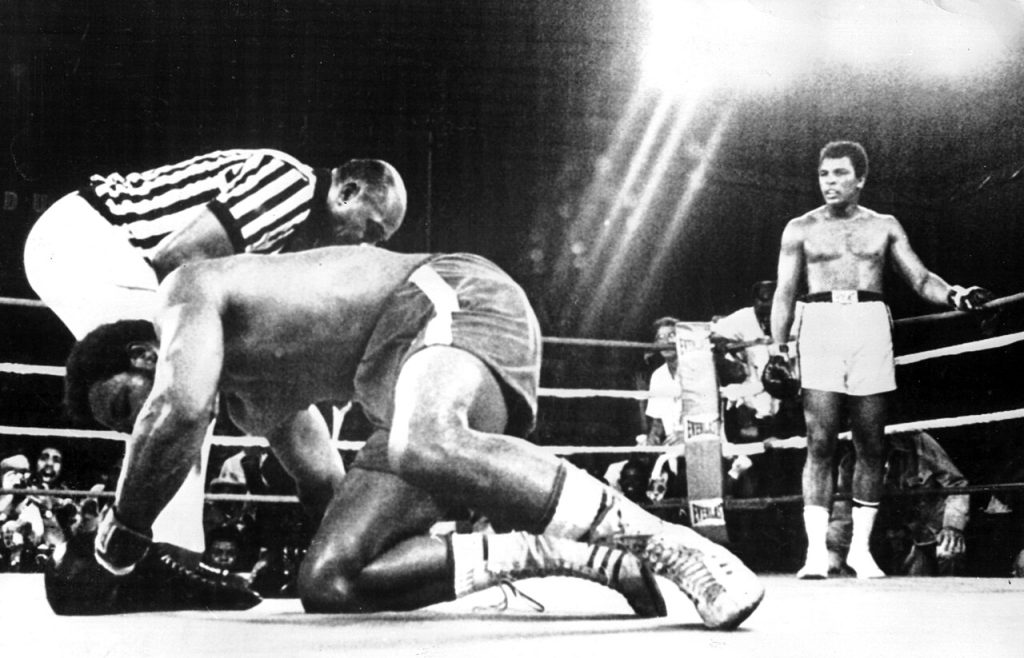
By the eighth, Foreman’s punches had slowed badly. Late in the round Ali came off the ropes with a fast combination, finishing with a left and a right that sent Foreman spinning to the canvas. Referee Zack Clayton counted him out. Ali had regained the title taken from him outside the ring in 1967.
The judges had Ali ahead at the stoppage, 68-66, 70-67 and 69-66, so the knockout ended a contest he was already winning. About 60,000 people were inside the Stade du 20 Mai. Ali kept up the taunting throughout, telling the champion, “They told me you could punch, George!” and, as the punches weakened, “That all you got, George?”
What came after
The audience was enormous for 1974. An estimated 50 million people watched on closed-circuit television, a record at the time, and BBC One drew 26 million viewers in Britain. The event is estimated to have grossed $100 million. Its reach grew with time. A music festival, Zaire 74, had run in Kinshasa from 22 to 24 September with James Brown, B.B. King and Celia Cruz on the bill. Footage from the whole adventure became Leon Gast’s documentary When We Were Kings, released in 1996, which won the Academy Award for best documentary feature.
Foreman took years to make peace with the loss. He retired in 1977, became a preacher, returned to boxing a decade later and in November 1994, aged 45, knocked out Michael Moorer to become the oldest heavyweight champion in history. He and Ali became friends in later life. “I am not closer to anyone else in this life than I am to Muhammad Ali,” Foreman told the Telegraph in 2012. Ali died in June 2016 and Foreman in March 2025, and the ring they shared in Kinshasa still gets cited whenever a heavy favourite walks into a plan he did not see coming.