When Oleksandr Usyk beat Tyson Fury in Riyadh in May 2024, he became the first undisputed heavyweight champion in a quarter of a century. Lennox Lewis had unified the division in 1999, but the WBO had since been accepted as a fourth major belt, and no heavyweight had managed to collect all four. Usyk held them for barely a month. One of the organisations stripped him for agreeing to a rematch with Fury instead of fighting its mandatory challenger. That, in a few weeks, is boxing’s title system.
Four sanctioning bodies
Most sports have one governing body and one champion. Professional boxing has four major sanctioning bodies, each crowning its own world champion in each weight class:
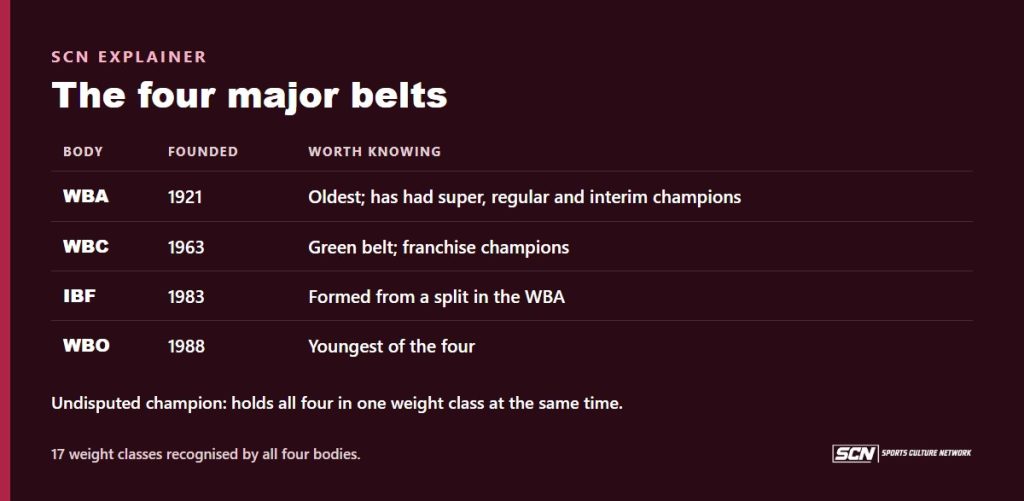
- WBA, the World Boxing Association, which began in 1921 as the National Boxing Association in the United States and took its current name in 1962.
- WBC, the World Boxing Council, founded in 1963 and based in Mexico City. Its green belt is the most recognisable in the sport.
- IBF, the International Boxing Federation, formed in 1983 after a split within the WBA.
- WBO, the World Boxing Organization, founded in 1988 and accepted as a major body by the 2000s.
These organisations rank fighters, sanction title fights and collect fees for doing so, usually a small percentage of each champion’s purse. They are not leagues. They do not promote fights or employ boxers. Promoters and television companies decide who fights whom, and the sanctioning bodies decide whether a title is on the line.
Alongside them sits The Ring magazine, which has awarded its own championship belt since 1922. It was intended to recognise the “lineal” champion, the fighter who beat the man who beat the man. In 2024 the magazine was bought by Turki Alalshikh, the Saudi official who has become one of the most powerful figures in boxing, and its belt has since been used heavily in the big Saudi-backed events.
Seventeen weight classes
Fighters are divided by weight, from minimumweight (105 pounds) up to heavyweight (over 200 pounds), with 17 divisions recognised by all the major bodies. The WBC added an 18th, bridgerweight, between cruiserweight and heavyweight in 2020, though the others have not followed. With four bodies and 17 weights, there can be 68 or more men’s “world champions” at once, before counting women’s divisions.
Boxers weigh in the day before a fight, so many dehydrate to make weight and rehydrate overnight, coming into the ring several pounds heavier. Missing weight usually means a fine and, in a title fight, the title cannot be won by the fighter who came in heavy.
More belts than champions
The sanctioning bodies have added extra titles over the years, which confuses even regular fans. The WBA has at times had a “super” champion, a “regular” champion and an “interim” champion in the same division. The WBC has “franchise” champions, a status given to its biggest stars that frees them from some obligations, along with interim, silver and other titles. Interim belts are supposed to be held while a champion is injured or inactive. In practice they often exist because a fight needed a title to sell.
Critics say the extra belts devalue the sport and exist mainly to collect more fees. Supporters say they give more fighters a route to a big payday. Most fans and writers simply try to identify who the real best fighter in each division is, and rely on independent rankings, such as The Ring‘s and those of the Transnational Boxing Rankings Board, to do it.
Mandatory challengers
Each sanctioning body keeps its own rankings and periodically orders its champion to fight its top contender, the mandatory challenger. If the champion refuses, perhaps because a bigger and more lucrative fight is available elsewhere, the body can strip him of its title.
That is the main reason undisputed champions are so rare. Each of four organisations makes its own demands, on its own timetable, and a champion trying to hold all four belts has to satisfy every one of them or lose a title. Usyk’s IBF belt went that way in 2024. Many champions decide that one or two belts and the biggest fights are worth more than collecting all four.
What “undisputed” means
An undisputed champion holds all four major belts in a division at the same time. Before the WBO’s arrival, the word applied to a fighter with the WBA, WBC and IBF titles, as Mike Tyson had in the late 1980s and Lewis in 1999.
The four-belt era has produced a small, celebrated group. Canelo Álvarez became the first undisputed super middleweight in 2021. Naoya Inoue of Japan has been undisputed at bantamweight and super bantamweight. Terence Crawford became undisputed at super lightweight and welterweight, then beat Canelo in Las Vegas in September 2025 to become undisputed at super middleweight, making him the first man to be undisputed in three weight classes in the four-belt era. In women’s boxing, Claressa Shields, Katie Taylor and others have become undisputed champions, sometimes in more than one division.
How title fights are made
Title fights are business deals. Promoters such as Top Rank, Matchroom, Golden Boy and Queensberry negotiate with each other, with the fighters’ teams and with broadcasters and streaming services. Money from Saudi Arabia’s General Entertainment Authority has funded many of the biggest fights since 2023, with events in Riyadh, London and Las Vegas. The sanctioning bodies set the rules on rankings, mandatory defences and purse bids, the auction used to settle a title fight when the promoters cannot agree.
That arrangement explains a lot of boxing’s frustrations: fights fans want that never happen, champions who duck mandatory challengers, and titles changing hands at the negotiating table rather than in the ring. It also explains why the undisputed nights, when every belt is on the line and the best fight the best, are the sport’s biggest events.
Follow the fights in our fight coverage, and read how UFC rankings and title shots work for a sport that went the other way, with one organisation and one champion per division.