In 1962, in a New York hotel room during an Oakland Raiders road trip, a part-owner of the club named Bill Winkenbach sat down with a team PR man and a local sportswriter and drew up the rules for a game based on real players’ statistics. They called it the Greater Oakland Professional Pigskin Prognosticators League. Sixty years later the idea has tens of millions of players across the United States and Canada, a fantasy segment on every NFL pregame show and an industry worth billions. The basics are still close to what Winkenbach wrote down.
The idea
You and a group of friends, co-workers or strangers each build a team of real NFL players. Every week, those players earn points for your team based on what they do on the field: yards gained, touchdowns scored, passes caught. You play one other team in your league each week, and whoever’s players score more points wins. At the end of the regular season the best records go into a playoff, and one manager is crowned champion.
You are not a fan of one team any more. You are a fan of your wide receiver from Cincinnati, your running back from Detroit and your quarterback from Buffalo, and you will find yourself watching a meaningless Thursday night game because your tight end is playing in it.
Setting up a league
Most leagues have 10 or 12 teams and run on a free app from ESPN, Yahoo, the NFL, Sleeper or CBS. The commissioner, usually the person who sent the invitations, sets the rules: how many players start each week, how points are scored, when trades are allowed and how the playoffs work.
A typical starting line-up is one quarterback, two running backs, two wide receivers, one tight end, one “flex” spot that can be filled by a running back, receiver or tight end, a kicker and a team defence. Each manager also carries five or six bench players to cover injuries and bye weeks, the one week each season when every NFL team has a rest.
The draft
The draft, usually held in late August or early September, is the biggest night of the fantasy year, and for many leagues it is an excuse for a party. There are two main formats.
In a snake draft, managers take turns picking players. The order reverses every round, so the manager with the first pick in round one picks last in round two, then first again in round three. It keeps things fair: whoever lands the best player waits longest for the next one.
In an auction draft, every manager gets the same budget, often $200 in imaginary money, and bids on players one at a time. Anyone can buy any player if they are willing to pay. Auctions take longer and reward planning, and some managers swear they are the only proper way to play.
Draft strategy is endlessly argued. For years the standard approach was to take running backs early, because good ones were scarce. More recently, receivers have gone just as high, and some managers wait on quarterbacks until the middle rounds, because the gap between the fifth and fifteenth best quarterback is smaller than at other positions.
How points are scored
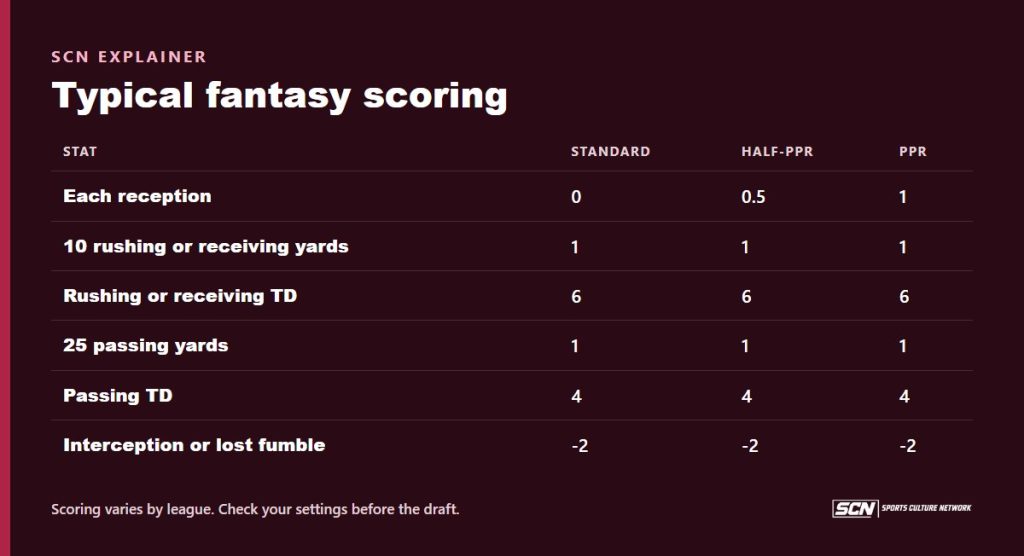
Scoring settings vary, but most leagues use something close to this:
- 1 point for every 10 rushing or receiving yards
- 6 points for a rushing or receiving touchdown
- 1 point for every 25 passing yards and 4 points for a passing touchdown
- minus 2 points for an interception or a lost fumble
- points for kickers by distance of field goal, and for defences by sacks, turnovers and points allowed
The biggest variation is the reception. In PPR (point per reception) leagues, every catch is worth a point, which lifts receivers and pass-catching running backs. Half-PPR gives half a point. Standard leagues give nothing for the catch itself. Before a draft, it is worth knowing which one you are playing, because it changes the value of half the players on the board.
The weekly routine
Each week you set your line-up before kick-off, choosing who starts and who sits. That is where most leagues are won and lost. Injury reports come out through the week, and Sunday morning brings late scratches, so experienced managers check their teams an hour before the early games.
Players nobody drafted sit on the waiver wire. When an injury creates a new starter or an unknown receiver catches ten passes, managers race to pick him up. To keep it fair, most leagues process claims overnight, either in a rotating priority order or through a blind bidding system called FAAB (free agent acquisition budget), where each manager gets a season-long budget and bids on players.
Managers can also trade with each other, until a trade deadline usually set in November. Lopsided trades between friends are a classic source of league arguments, which is why many leagues let other managers vote to veto a deal.
Playoffs and the trophy
Most fantasy regular seasons run for 14 weeks, followed by playoffs in weeks 15 to 17. Leagues avoid the NFL’s final week, Week 18, because teams that have clinched their place often rest their stars. That makes late-season NFL games matter to fantasy managers in ways the real teams never consider, and a running back’s rest day can decide a league title.
Many leagues play for money, a trophy or both, and the last-place finisher often faces a punishment chosen at the draft. Losing a fantasy league can cost you a day sitting in a Waffle House or wearing an embarrassing shirt to work.
Other ways to play
Keeper leagues let each manager keep a few players from one season to the next. Dynasty leagues go further, keeping whole rosters year after year and adding rookies through their own draft, so managers end up running something closer to a real front office.
Daily fantasy, run by companies such as DraftKings and FanDuel, drops the season-long commitment. Players build a new line-up each week under a salary cap and play for cash prizes. It is regulated differently from season-long leagues, and its legal status varies from state to state.
Best ball leagues remove the weekly decisions altogether. You draft, and the app automatically counts your highest-scoring players each week.
Why the NFL loves it
Fantasy football changed how people watch the sport. Fans now follow every game rather than just their own team’s, which helped make the NFL’s Sunday afternoon whip-around channel, NFL RedZone, a success. The league once kept its distance from anything that looked like gambling. Today it runs its own fantasy game, shows fantasy stats on its broadcasts and treats fantasy players as some of its most engaged fans.
The game has stayed popular for the same reason it started in a hotel room. It gives a group of friends a reason to talk to each other every week from September to January, and a reason to care about a fourth-string running back in the fourth quarter of a blowout.
Keep up with injuries, depth charts and breakout players in our NFL coverage, and read how the NFL playoffs work to see why Week 18 is so unpredictable.