In February 2026 the NFL told its 32 teams that each of them could spend up to $301.2 million on players for the coming season. It was the first time the salary cap had passed $300 million, a jump of $22 million on the year before and around 40% in five seasons, driven by the league’s huge television deals. Teams will spend almost all of it, and plenty will spend some of it on players who no longer play for them. That is how the NFL’s cap works.
A hard cap
Unlike the NBA’s soft cap, the NFL’s is hard. No team can be over it at any point in the league year, which starts in March, and there are no exceptions for re-signing your own players. Teams also have to meet a minimum spend over several seasons. The figure is set each year by the collective bargaining agreement, which gives players a share of around 48% of league revenue. The current agreement, signed in 2020, runs through the 2030 season.
The cap counts every player under contract, including those on injured reserve. What counts is not simply what a player is paid that year but his cap hit, a number that depends on how his contract is built.
Signing bonuses and proration
The key to almost every big NFL contract is the signing bonus. A player receives it up front, but for cap purposes it is spread evenly across the contract, up to a maximum of five years. A $50 million bonus on a five-year deal counts $10 million a year against the cap, even though the money left the team’s bank account on day one.
That gives teams a way to fit stars under the cap in the short term. They can also restructure an existing contract, turning a player’s salary for the coming season into a bonus and spreading it over the remaining years. Restructures are routine, especially in March when teams need room to sign free agents. They do not save money. They move cap costs into the future.
Void years
To spread bonuses even further, teams add fake years to the end of contracts, known as void years. A player signs a deal that says it runs for five years, but the last two automatically void. The bonus can now be spread over five years instead of three. When the contract voids, the remaining bonus money still has to be counted. Clubs including the New Orleans Saints have used void years so heavily that they have carried large sums for players who were long gone.
Dead money
When a team cuts or trades a player, any signing bonus that has not yet been counted against the cap comes due immediately, along with any guaranteed salary still owed. This is dead money, and every front office has some. It is the reason a team might keep an expensive, declining veteran for another year: releasing him would cost more cap space than keeping him.
The league offers some flexibility. A player released after June 1, or designated as a post-June 1 release earlier in the year, has his dead money split over two seasons. Teams also save money by rolling over unused cap space from one year to the next, which is allowed without limit.
The most notorious example of dead money remains the Denver Broncos’ release of Russell Wilson in 2024, which left the club with a record charge of around $85 million spread over two seasons for a quarterback playing for someone else.
The franchise tag
Each year a team can use one franchise tag on a player whose contract is about to expire. The tag gives him a one-year deal at a set price and stops him from becoming a free agent. Teams have a two-week window in late February and early March to apply it.
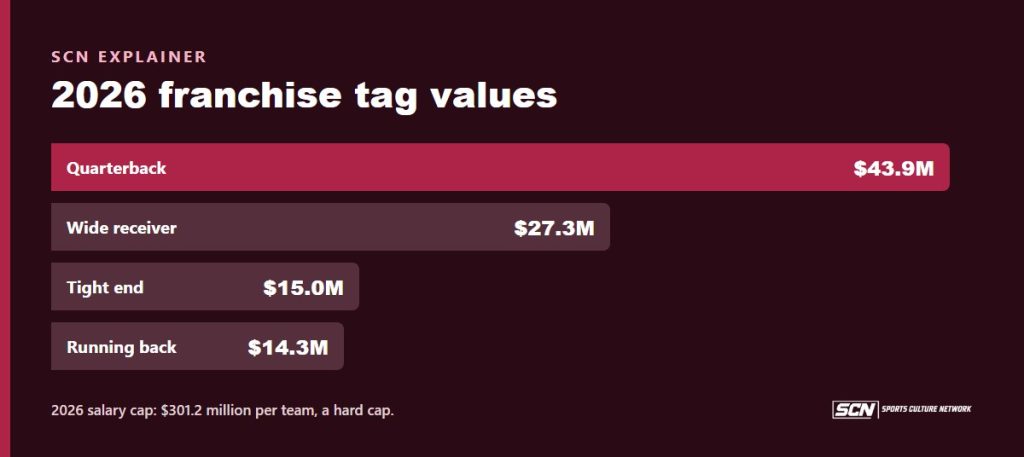
The price depends on the player’s position. It is calculated from the highest salaries at that position across the league over recent years, linked to the growth of the cap, or 120% of the player’s previous salary if that is higher. For 2026 the quarterback tag was worth $43.895 million, wide receivers $27.298 million, tight ends $15.045 million and running backs $14.293 million. The gap tells you how the league values each position.
There are two kinds of franchise tag. The exclusive tag, priced from the current year’s top salaries, means no other team can negotiate with the player. The non-exclusive tag lets other teams make an offer, but the original team can match it, and if it doesn’t, it receives two first-round picks as compensation. That price is so steep that offer sheets almost never happen.
There is also a cheaper transition tag, based on the top ten salaries at the position, which gives the team the right to match an offer but no compensation if it declines.
A tagged player and his team have until mid-July to agree a long-term contract. After that deadline he must play the season on the one-year tag or sit out.
Why players hate it
The tag protects teams, but players see it as a way of denying them the security of a long-term deal at the moment they are most valuable. A running back, whose career is short and whose body takes a beating, has the most to lose from another year on a one-year contract.
Some have refused to play on it. Le’Veon Bell, Pittsburgh’s star running back, sat out the whole 2018 season rather than play a second year on the tag. Kirk Cousins played on the tag twice for Washington, in 2016 and 2017, then left in free agency and signed a fully guaranteed contract with Minnesota. Dak Prescott played the 2020 season on the tag before Dallas finally signed him to a long-term deal in 2021.
The cost rises each time a team uses it on the same player. A second tag costs 120% of the previous one, and a third costs either the quarterback tag or 144% of the previous year’s, whichever is higher. A third tag on a non-quarterback is almost unheard of.
Guaranteed money
NFL contracts are famous for their headline numbers, but the important figure is the guarantee. Most contracts are not fully guaranteed, so a team can cut a player and stop paying him. When a deal is reported as “four years, $200 million”, the real measure is how much of it is guaranteed at signing. The Cleveland Browns’ fully guaranteed $230 million contract for Deshaun Watson in 2022 broke that norm and set off years of argument among owners about whether others would be forced to follow.
Reading a contract
Once you know the rules, the moves make sense. A team that “restructures” its quarterback in March is creating room now by pushing costs into later years. A team carrying “dead money” is paying for an old mistake. A player who is “franchised” will either sign a long deal by July or spend the season on a one-year contract hoping for a bigger one later. And a team with lots of cap space is not necessarily well run. It may simply have no one worth paying.
Follow free agency, trades and contract news in our NFL coverage, and read how the NFL Draft works for the cheapest way to build a roster: rookie contracts.