For most of a century, the NCAA’s central rule was that college athletes could not be paid. A booster’s envelope of cash or a free car could cost a programme its bowl games. By 2026, schools were writing cheques to their players directly, quarterbacks were earning more than some NFL starters, and thousands of athletes were changing teams every winter. The change took barely five years.
How the old rules fell
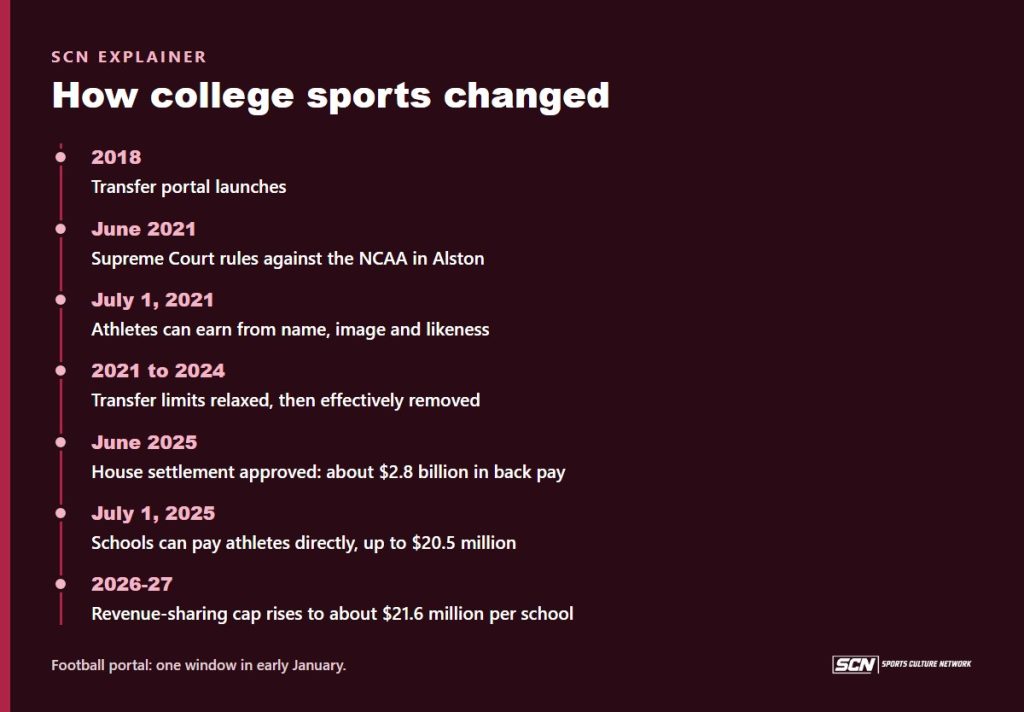
The amateur model was challenged in court for decades. It cracked in 2021. In June that year the Supreme Court ruled unanimously in NCAA v. Alston that the NCAA could not cap education-related benefits, and Justice Brett Kavanaugh wrote that the association’s business model “would be flatly illegal in almost any other industry in America”. Days later, on July 1, 2021, state laws came into force allowing athletes to earn money from their name, image and likeness, and the NCAA dropped its ban nationwide.
The rules on moving schools changed in the same period. The transfer portal, a database where athletes declare they want to leave, launched in 2018. In 2021 the NCAA let athletes transfer once without sitting out a season, and in 2024, after legal challenges, it effectively removed the limit altogether.
What NIL means
NIL stands for name, image and likeness. It covers any deal where an athlete is paid for the use of his or her identity: an advert for a local car dealer, a paid social media post, a signing event, a shoe deal or a video game appearance. The biggest stars, in football, basketball and some women’s sports, earn millions.
The money soon went beyond endorsements. Boosters at many schools formed “collectives”, groups that pooled donations and paid athletes, often in exchange for little more than appearances. In practice, collectives became a way to pay players to come or to stay, and recruiting turned into an open market.
The House settlement
The next step came from a class-action case, House v. NCAA, brought by athletes who said they had been denied a share of television money. In June 2025 Judge Claudia Wilken approved a settlement between the NCAA, its biggest conferences and the plaintiffs. It changed the system in three main ways.
First, it provided around $2.8 billion in back pay to athletes who played before NIL was allowed.
Second, it allowed schools to pay their athletes directly for the first time. From July 1, 2025, each school could share up to $20.5 million a year with its athletes. The cap rises each year, and for 2026-27 it is set at about $21.6 million per school. Most of that money goes to football and men’s basketball players, though schools decide how to split it.
Third, it replaced scholarship limits with roster limits. Football teams can now carry up to 105 players, and schools can give scholarships to all of them if they choose.
The settlement created a new body, the College Sports Commission, to enforce the rules. Any outside NIL deal worth more than $600 must be reported to a clearinghouse, which checks whether it is for a real business purpose and at a fair market rate. The aim is to stop collectives using fake endorsement deals to get around the revenue-sharing cap.
How the transfer portal works
An athlete who wants to leave asks his school’s compliance office to enter his name in the portal. From that moment, other schools can contact him. He is not guaranteed a place anywhere, and some players who enter the portal end up without a team.
Players can only enter during set windows. For football, after several changes, there is now a single window in early January, after the regular season and conference championships. The spring window was scrapped to give coaches a stable roster after spring practice. Teams still playing in the College Football Playoff when the window opens get a short window of their own once their season ends. Other sports have their own windows.
The portal now dominates roster building. Every January brings a rush of moves, and coaches spend as much time recruiting transfers as high school players. Experienced quarterbacks, who can transform a team in one season, are the most sought-after, and the best of them can earn several million dollars a year.
The effects
Supporters of the new system say athletes are finally getting a share of the billions their sports generate, and that players can now leave a bad situation, a coach who leaves or a lack of playing time, without losing a year.
Critics say it has turned college sport into free agency without a salary cap that anyone can enforce, that rosters change so much each year that fans barely know their own team, and that the richest schools can now simply buy the best players. Smaller programmes complain that they develop talent only to lose it to bigger schools after one good season.
There are open questions too. Whether athletes should be treated as employees, with the rights that brings, is still being argued in courts and in Congress, as is whether a federal law should replace the patchwork of state NIL rules. Women’s sports and smaller men’s sports worry that the revenue-sharing money will be concentrated in football and basketball. And nobody yet knows whether the College Sports Commission can enforce the rules any better than the NCAA did.
What it means for fans
The changes explain a lot of what now happens on the field. A team can go from a losing record to playoff contender in a single off-season by recruiting well in January. A star freshman may not be there as a sophomore. A school’s boosters and its revenue-sharing budget matter as much as its coach and its facilities. And the end of the season is no longer the end of the drama. For many fans, the transfer portal window has become a second recruiting season, followed as closely as signing day used to be.
Follow the portal, the rankings and the playoff race in our college football coverage, and read how the College Football Playoff works. For the next step in a player’s career, see how the NFL Draft works.