In January 2011 the Seattle Seahawks hosted the defending Super Bowl champions with a 7-9 record. Marshawn Lynch broke six tackles on a 67-yard run, the ground shook hard enough to register on a seismograph, and Seattle won 41-36. The Seahawks had no business being at home that day by any normal measure. They were there because they had won the NFC West, and in the NFL, winning your division buys you a home playoff game no matter how ugly the record.
That rule is the first thing to understand about the NFL postseason. The rest follows from it.
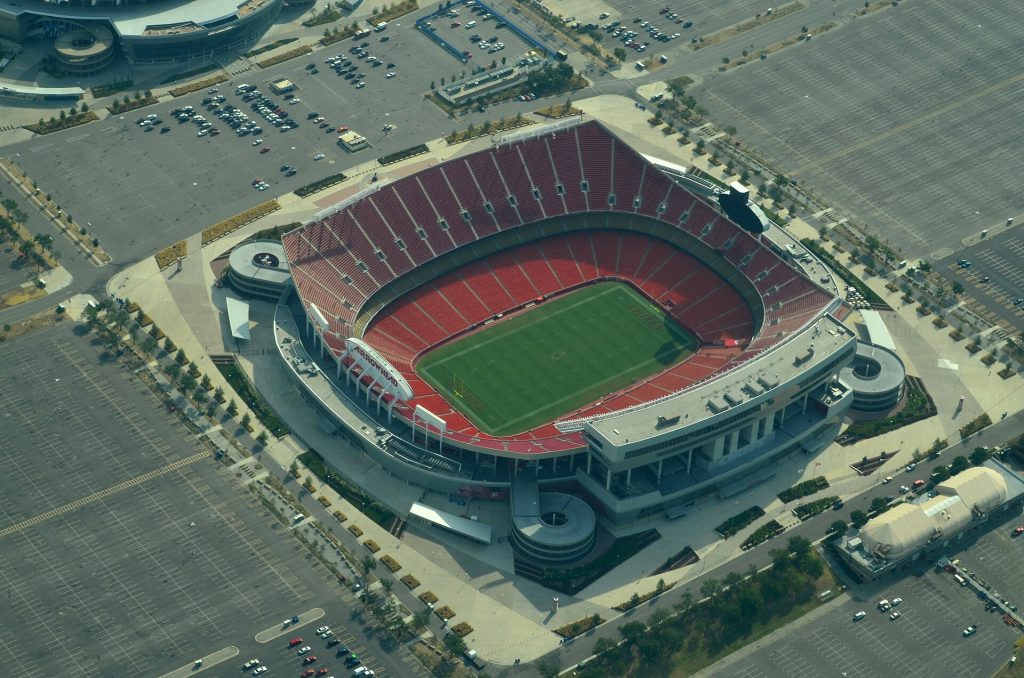
Fourteen teams, seven per conference
The league’s 32 teams are split into the American Football Conference and the National Football Conference, and each conference has four divisions of four. After 18 weeks and 17 games, seven teams from each conference go through.
The four division winners take seeds one to four, ranked by record. The three best teams who did not win their division fill seeds five to seven as wild cards. A wild card cannot climb above fifth, even with the best record in the conference. Detroit tried to change that in 2025 with a proposal to seed all seven teams on record alone, but the Lions pulled it before owners voted when it became clear the support wasn’t there.
So a 13-4 wild card can open the playoffs on the road against a 9-8 division champion. It produces a grievance or two every January. The league has stuck with it because it keeps every division race alive until the last week of the season.
The bye is the prize
Until 2020 the top two seeds in each conference got a week off. When the league expanded the field from 12 teams to 14, it kept the bye only for the No. 1 seed. That made first place in the conference the most valuable thing on offer in the regular season.
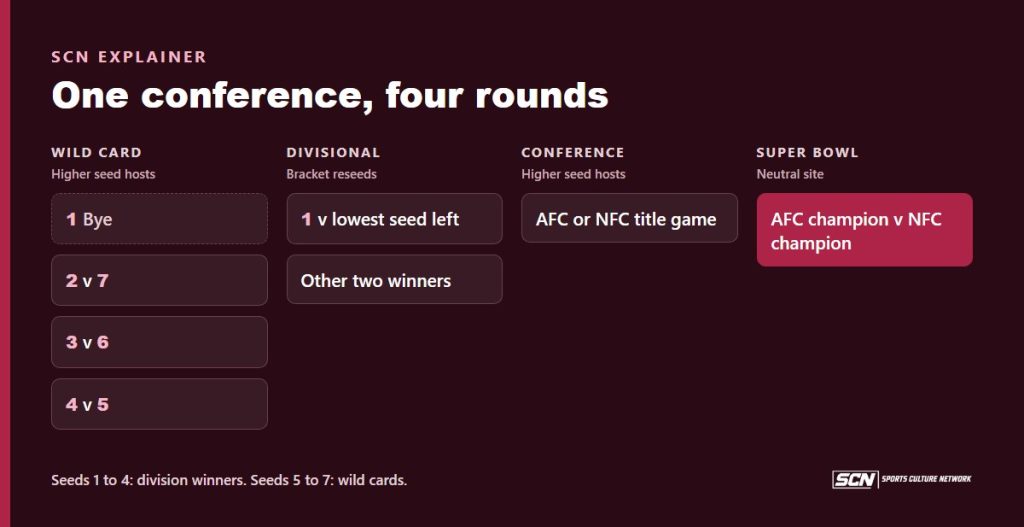
Wild Card Weekend pairs the No. 2 seed with the No. 7, the No. 3 with the No. 6 and the No. 4 with the No. 5. The higher seed hosts. The top seed rests, heals and waits, knowing it will be at home for every game until the Super Bowl.
Six games are spread across a long weekend, usually starting Saturday afternoon and ending on Monday night.
A bracket that redraws itself
March Madness fans fill in a bracket once and live with it. The NFL does not work that way. After every round the remaining teams are reseeded, and the top seed still standing always plays the lowest.
If the favourites all win on Wild Card Weekend, the No. 1 seed gets the No. 4 in the Divisional Round. If the No. 7 pulls off an upset, it goes to the No. 1. The same logic sets up the two conference championship games the following weekend, with the higher seed at home again. The winners become AFC and NFC champions and meet in the Super Bowl.
There are two weeks between the conference title games and the Super Bowl, the only game of the postseason played at a neutral site. Owners pick host stadiums years in advance, so on rare occasions a team ends up playing for the title in its own building. Tampa Bay did it in Super Bowl LV and the Los Angeles Rams did it a year later in Super Bowl LVI. Both won.
When records are level
With 17 games and a lot of parity, ties in the standings are routine, and the league settles them with a fixed order of tiebreakers. For two teams fighting over a division, the first test is their head-to-head record. If that doesn’t separate them, the league looks at record inside the division, then record in common games, then record inside the conference.
After that it gets more abstract. Strength of victory is the combined record of the teams you beat. Strength of schedule is the combined record of everyone you played. Points scored and allowed come next, and at the very bottom of the list sits a coin toss that has never been needed to decide a playoff place.
Wild-card ties use a similar ladder but move conference record up the order, because the teams involved may never have played each other. Three-way and four-way ties are settled inside divisions first, which is why final-week scenarios published by the league can run several pages.
One quirk worth knowing: a regular-season tie counts as half a win and half a loss. A 10-6-1 team has a winning percentage of .618 and finishes ahead of a 10-7 team at .588.
Overtime
A playoff game cannot end level. Extra periods run for 15 minutes, and both teams are now guaranteed the ball at least once, even if the first team to possess scores a touchdown.
That rule exists because of one night in Kansas City. In the 2021 Divisional Round, the Chiefs and Buffalo Bills traded scores until the final seconds, Kansas City won the coin toss in overtime, and Patrick Mahomes drove the length of the field for a touchdown. Josh Allen, who had just produced one of the great quarterback performances in playoff history, never got the ball back. The league changed the playoff rule before the next season and extended it to the regular season in 2024.
Once both sides have had a possession, the next score wins. If it is still tied after a full period, they play another.
Is home field really worth it?
Home teams have won the clear majority of NFL playoff games over the years, and anyone who has watched a dome team try to throw the ball in Green Bay or Buffalo in January can see why. Players sleep in their own beds, the quarterback can hear his own snap count and the crowd works against the opposing offence on third down.
That edge explains the scramble for seeds in December. It also explains why a team that has already locked up its spot will sometimes sit its starters in Week 18. A healthy roster on the road can still beat a battered one at home, and every head coach has had to decide which risk scares him more.
The seventh seed’s long wait
Wild cards have won the Super Bowl before. Tom Brady’s Buccaneers did it as a No. 5 seed in the 2020 season, winning three road games and then the final in Tampa. No seventh seed has done it since the format arrived, and history suggests it will take a special team. The road means four straight wins, at least three of them away from home, starting with the second-best team in the conference.
Follow the race to January in our NFL coverage. For the college side of the sport, read how the College Football Playoff works, and for what happens to the teams who miss out, see how the NFL Draft works.