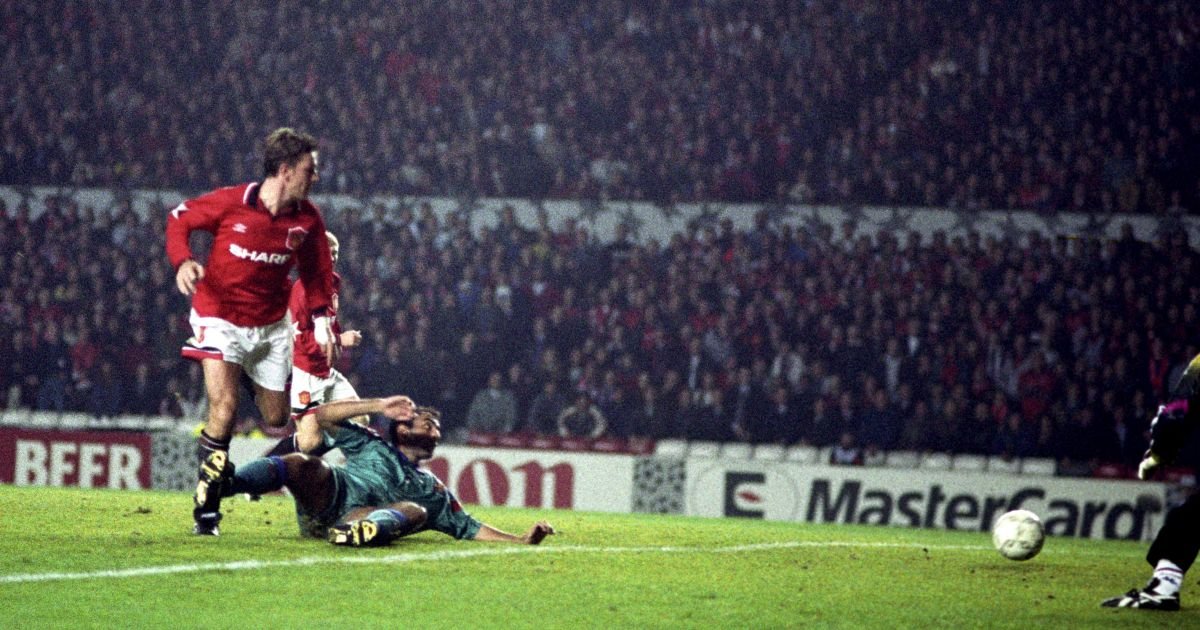
Lee Sharpe’s flick against Barcelona in the 1994-95 Champions League remains one of Manchester United’s most memorable moments from that era, despite the season ending without silverware. The goal came in the 80th minute of a 2-2 draw at Old Trafford, a rare moment of brilliance during a campaign that saw few highlights for the club.
United had entered the match without much fanfare, coming off a season where they retained the Premier League and added the FA Cup but fell short of a domestic treble after losing the League Cup final to Aston Villa. The 1994-95 season itself was less successful, with only two summer signings—David May and Graeme Tomlinson—and a trophyless finish, losing the Premier League title to Blackburn.
Sharpe’s goal was notable not just for its timing but for the style. Receiving a cross from Roy Keane, who wore the No.9 shirt that season, Sharpe delivered a flick that defied easy description. It wasn’t a simple backheel nor a conventional outside-foot kick; the move has resisted a formal name, despite its repeated viewings and admiration. The goal’s execution left defenders and keeper stranded, with a defender sliding in without making contact and the goalkeeper diving in vain. The reaction was equally memorable, with the steward throwing his hands in the air and Sharpe turning back to watch the ball hit the net before celebrating with the “Sharpey Shuffle” in front of the posts.
The goal was Sharpe’s last in the Champions League. He was injured for the return leg at Camp Nou, which United lost 4-0. After finishing second in the league behind Blackburn, United competed in the UEFA Cup the following season, 1995-96, which was Sharpe’s final campaign before his move to Leeds United.
While Ryan Giggs and Andrei Kanchelskis would go on to have more sustained success at United, and David Beckham was on the rise, Sharpe’s peak came during the 1993-94 season when he scored 11 goals in 41 appearances. That period also saw Eric Cantona netting 25 goals and Mark Hughes 22. Paul Ince has said that this early 90s United team could have beaten the treble-winning side of 1998-99, reflecting the strength and excitement around the squad at the time.
The 1994-95 season may lack the trophies and acclaim of other United sides, but Sharpe’s goal against Barcelona has remained a highlight for fans and football historians. It captures a moment of flair and spontaneity that feels distinctly 90s, matching Sharpe’s reputation for style both on and off the pitch.
The goal has been shared widely on social media and football archives, often described as “brilliant” and “beautiful.” It stands out not only for its technical quality but also for the context—a late equaliser in a European fixture against a top club.
As Sharpe’s contribution to United’s history is remembered, the flick he invented continues to invite admiration and a search for the right term to describe it. For many, it is simply a classic moment from a team that bridged the gap between the early Premier League triumphs and the Champions League glory that would follow.
According to Planet Football.