
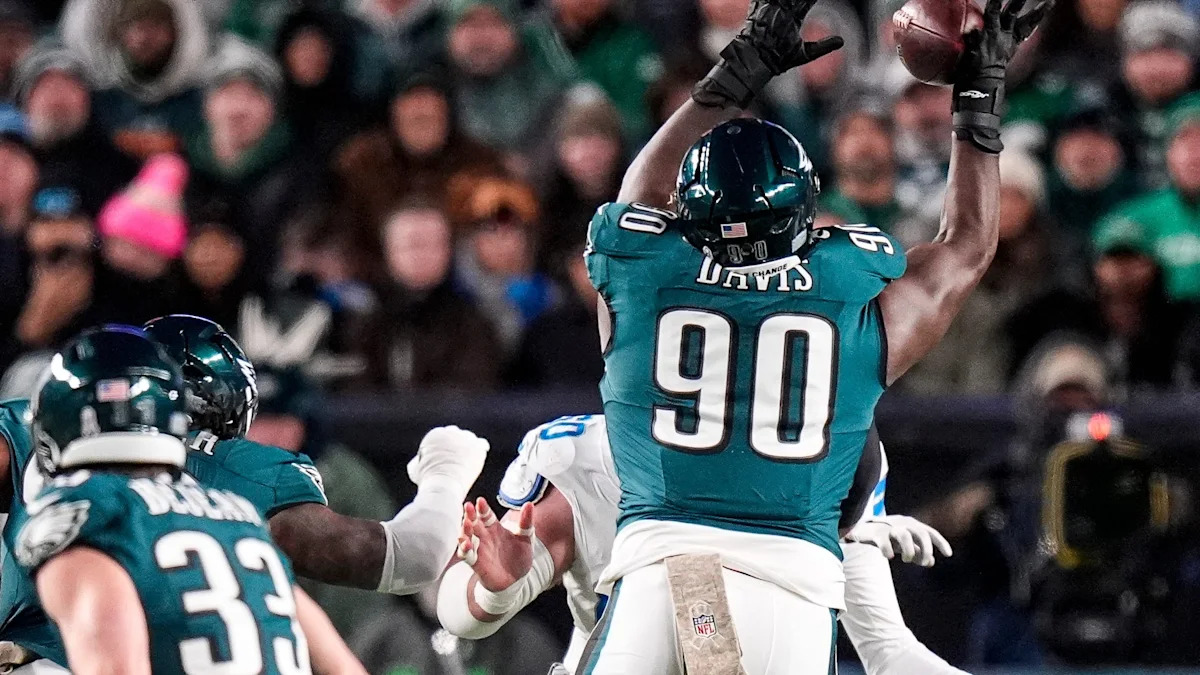
The Philadelphia Eagles have traded interior defender Jordan Davis to the Jacksonville Jaguars in exchange for a 2027 first-round pick and a 2029 second-round selection. The deal offers Philadelphia future assets but leaves a significant gap on the defensive line.
Davis appeared in 38 of 67 defensive snaps during his final game for the Eagles against the New York Giants. His presence in the middle helped Philadelphia contest running plays effectively, and his departure forces the team to reconsider how it defends similar formations with the personnel left on the roster.
The Eagles’ defensive rotation included Josh Sweat, Marlon Tuipulotu, and Jordan Davis as central figures. With Davis gone, the team relies more heavily on players such as Carter, Ojomo, Young, and Robinson. Against the Giants, Carter played 58 defensive snaps, Ojomo 42, Young 16, and Robinson 9, illustrating that Carter already carried a substantial workload. Simply increasing Carter’s snaps to cover Davis’s absence is not an option.
Davis’s impact extended beyond run defense. He recorded a sack in his final game and contributed on passing downs, offering fresh interior pressure and matchup flexibility. The Eagles now have fewer options to rotate interior rushers and must manage the remaining players’ fatigue over the course of a game.
Veteran experience was another factor Davis brought to the defense. He had played through several seasons, postseason appearances, and shifting defensive assignments in Philadelphia. That familiarity helped the team adjust formations and communicate assignments efficiently. While younger players may develop similar understanding over time, the transition demands preparation rather than expecting immediate replication of Davis’s performance.
The Eagles will likely adjust their defensive alignment to redistribute responsibilities across linebackers and defensive linemen. This shift changes how opponents are defended and what individual players must handle. Evaluating Davis’s contributions requires looking beyond tackles or sacks to consider his alignment, blocking matchups, and influence on plays.
Philadelphia’s front office clearly values the draft capital acquired in this deal. However, the defensive unit faces a challenge replacing an established contributor whose work cannot be filled by a single player. The next step is to see how the remaining personnel adapt to new roles and whether the defense can maintain its effectiveness while changing its operational approach.
The trade signals a focus on future team building but leaves immediate defensive adjustments in the hands of Eagles coaches and players. For now, the team moves forward without Jordan Davis, reshaping its interior defense and testing the depth of its rotation.
According to Yahoo Sports.