
Conor McGregor never fought for a UFC title from the number-one spot in the rankings, and it did not matter. In 2016 he challenged Eddie Alvarez for the lightweight belt while still holding the featherweight title, won in two rounds and became the first fighter to hold UFC championships in two weight classes at the same time. The fight happened because it was the biggest one the company could make. If you want to understand how the UFC decides who fights for its titles, start there.
One promotion, one champion
Unlike boxing, with its four sanctioning bodies, mixed martial arts at the top level is dominated by one company. The Ultimate Fighting Championship signs most of the world’s best fighters to exclusive contracts, so its champion in each division is generally recognised as the best in the world. Other promotions, such as the Professional Fighters League and ONE Championship, have their own titles, but the UFC belt is the one fighters want.

The UFC has eight men’s divisions, from flyweight (125 pounds) to heavyweight (up to 265 pounds), and women’s divisions at strawweight, flyweight and bantamweight. Each has one undisputed champion.
How the rankings are made
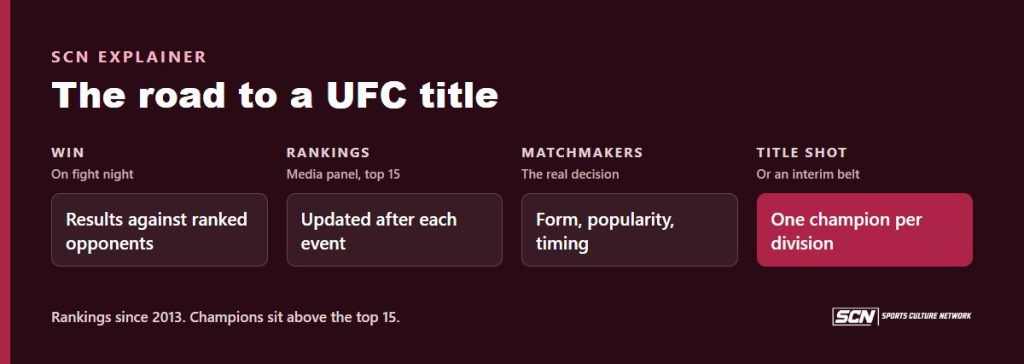
The UFC introduced official rankings in 2013. They are voted on by a panel of journalists and media members chosen by the company. Each voter ranks the top 15 fighters in each division, plus a pound-for-pound list that compares fighters across weight classes, and the votes are combined into the published rankings, which are updated after each event.
The champion sits above the list. Only active UFC fighters are eligible, and a fighter who moves up or down a weight class needs to compete there, or be voted in by the panel, before appearing in the new division’s rankings. Voters are asked to consider results, the quality of opponents and how recently a fighter competed, but they receive no formula.
The system has critics. Panel members have been accused of not watching enough fights, and the UFC has removed voters over the years for erratic ballots. Fighters sometimes complain that a single loss drops them several places while a win over a lower-ranked opponent barely moves them.
Who decides title shots
Rankings matter, but they do not decide title fights. The UFC’s matchmakers and executives do, led over the years by Dana White and, more recently, by chief business officer Hunter Campbell and a team of matchmakers. They look at rankings, recent form and how many fights a contender has won in a row, but also at whether the fight will sell, whether the fighters are available and healthy, and how it fits an event.
That is why a popular fighter can leapfrog the queue, and why a contender who has won six in a row can be kept waiting. Fighters know this, and many deliberately call out the champion or a star in post-fight interviews, trying to talk their way into a bigger fight. The best-known names can also choose to fight outside the title picture, as McGregor did against Nate Diaz in 2016 and as other stars have done when a “money fight” was more appealing than a title defence.
Interim titles
When a champion is injured or inactive for a long period, the UFC sometimes creates an interim title, contested by two leading contenders. The interim champion is meant to face the full champion when he returns, unifying the belts. If the champion cannot come back, the interim title holder is usually promoted.
Interim belts are useful when a division would otherwise stall, but they have also been created to add importance to a pay-per-view headline fight, and critics say they have been used too freely. Several divisions in recent years have spent long periods with both a champion and an interim champion waiting for a unification fight that kept being delayed.
Champions in two divisions
A handful of fighters have held UFC titles in two weight classes: Randy Couture, BJ Penn, McGregor, Daniel Cormier, Amanda Nunes, Henry Cejudo, Jon Jones, Georges St-Pierre, Alex Pereira, Ilia Topuria and Islam Makhachev among them. Only McGregor, Cormier, Nunes and Cejudo held both at the same time, and the UFC has usually asked double champions to give up one belt so the other division can keep moving. “Champion versus champion” fights, where a titleholder moves up to fight the champion of the next division, remain among the biggest events the company stages.
The BMF belt
The UFC also occasionally awards a one-off “BMF” belt, short for an expletive, first contested by Jorge Masvidal and Nate Diaz in 2019. It carries no ranking significance and exists purely as a showcase for exciting, popular fighters.
The business behind it
The UFC is part of TKO Group, formed in 2023 when the UFC’s owner, Endeavor, merged it with the professional wrestling company WWE. From 2026, the UFC’s events in the United States are shown on Paramount+ and CBS under a seven-year deal worth about $7.7 billion, replacing the pay-per-view model that sold its biggest fights for decades. Numbered events that once cost fans a separate fee are now part of a subscription.
The new model changes some incentives. Pay-per-view sales used to give stars a share of the revenue, which made a fighter’s drawing power a direct factor in who got the biggest fights. Fighter pay, and the share of revenue fighters receive compared with athletes in other major sports, has long been contested, including in antitrust lawsuits brought by former fighters that the UFC settled for hundreds of millions of dollars.
For fans, the practical lesson is the same as it has always been. The rankings tell you who has earned a shot. The matchmakers decide who gets one.
Follow every card in our fight coverage, and read how boxing’s world titles work for a sport with four champions in every division.