In 2000 the New England Patriots used the 199th pick of the draft on a skinny quarterback from Michigan who had run the 40-yard dash at the Combine in 5.28 seconds. Six quarterbacks went before Tom Brady that year. He won seven Super Bowls. Every April, as 32 teams spend three days choosing among a few hundred college players, the Brady pick is the story scouts tell each other: nobody really knows.
That uncertainty is what makes the draft one of the biggest events on the NFL calendar, even though no football is played.
Worst picks first
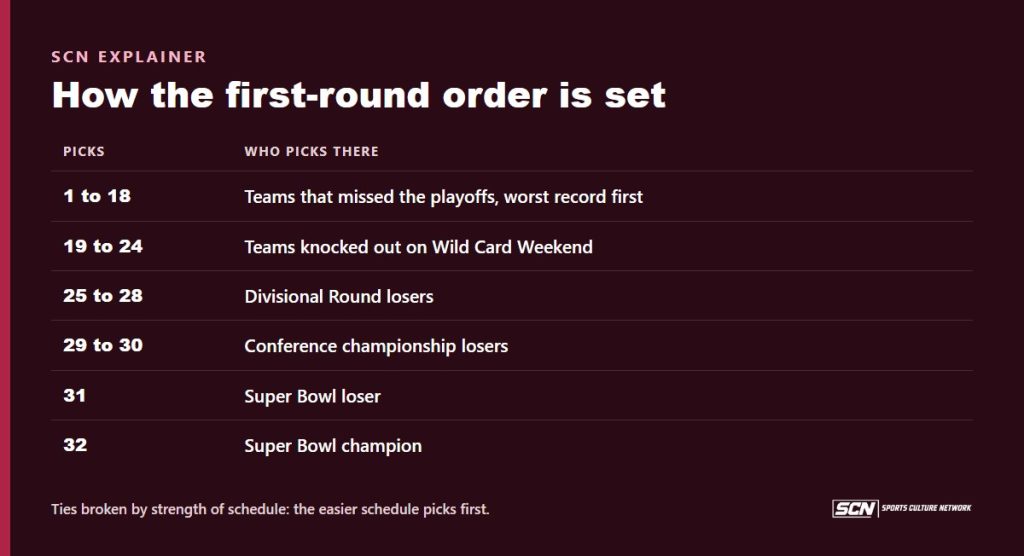
The draft exists so that bad teams can get better. The 18 clubs that miss the playoffs pick first in every round, ordered from worst record to best. The 14 playoff teams follow, ordered by how far they went. Teams knocked out on Wild Card Weekend pick 19 to 24, divisional losers 25 to 28, conference championship losers 29 and 30, the Super Bowl loser 31 and the champion last.
When records are level, the team with the weaker strength of schedule, meaning the lower combined record of its opponents, picks first. The thinking is that a team that lost against easy opponents is probably worse.
The NFL has no lottery. The worst team is guaranteed the first pick, which every few years produces a December debate about whether a struggling team is trying hard enough to win. The league has never found a team guilty of tanking, and players and coaches whose jobs depend on results rarely have any interest in losing.
Seven rounds, three days
The draft has seven rounds. The first is held on a Thursday night in prime time, rounds two and three on Friday, and rounds four to seven on Saturday. Teams get ten minutes per pick in the first round, seven in the second and less after that.
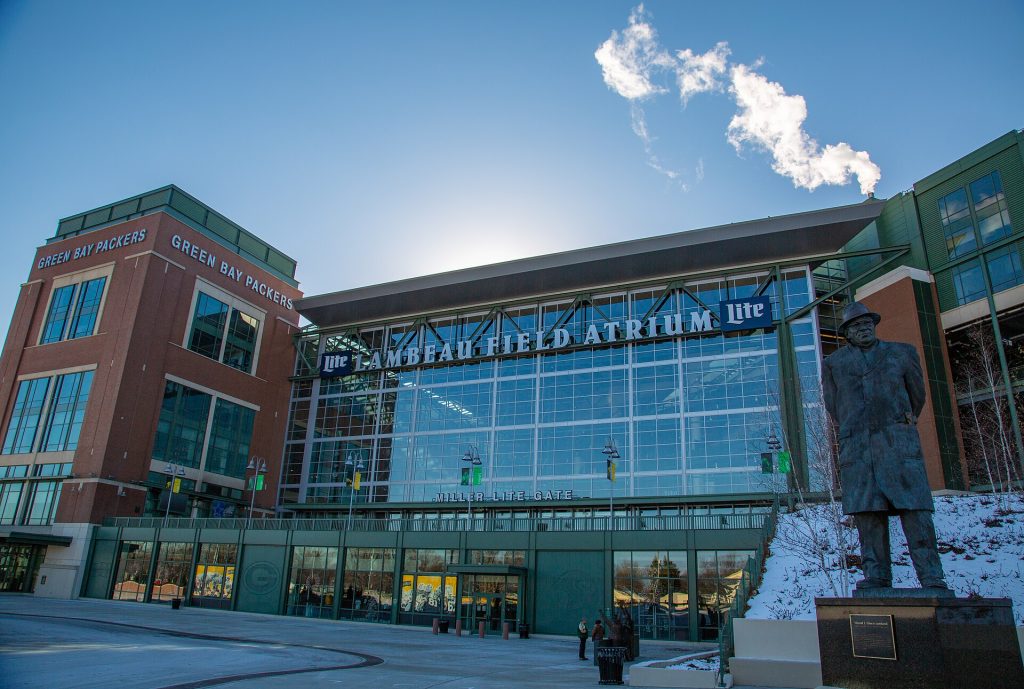
It travels. Since leaving New York in 2015, the draft has gone to Chicago, Philadelphia, Dallas, Nashville, Cleveland, Las Vegas, Kansas City, Detroit, Green Bay and Pittsburgh, often drawing hundreds of thousands of fans over three days. The 2027 draft is set for Washington, D.C., on April 29 to May 1.
Picks as currency
A draft pick can be traded at any time, including during the draft itself while a team is on the clock. Teams swap picks for veterans, for other picks and for the chance to move up for a player they love. A club can trade picks up to three years ahead.
To work out what a pick is worth, front offices have long used value charts. The original version, built by Dallas in the early 1990s under coach Jimmy Johnson, gave each pick a points value and is still a reference point. Newer charts based on analytics value the very top picks less steeply, because the history of the draft shows how often they miss.
Some of the biggest trades in recent years have been moves up the board for quarterbacks. When a team has a quarterback it believes in, it will pay several first-round picks to get him.
Compensatory picks
At the end of rounds three to seven, the league adds up to 32 extra picks. These compensatory picks go to teams that lost more, or better, free agents than they signed the previous year. A formula based on salary, playing time and post-season honours decides who gets them and where they fall.
They were long the one kind of pick that could not be traded. That changed in 2017, and teams now use them as freely as any other selection. A handful of other extra third-round picks are awarded to clubs that develop minority candidates who are hired as head coaches or general managers elsewhere.
Who can be drafted
A player must be at least three years out of high school. Most are college seniors or juniors, along with a few redshirt sophomores. Underclassmen must declare by a January deadline, and once they hire an agent they usually lose their remaining college eligibility.
The scouting process runs for months. The NFL Scouting Combine in Indianapolis in late February brings the top few hundred prospects together for medical exams, interviews and the measurable drills that fans obsess over: the 40-yard dash, the vertical jump, the bench press. College pro days follow in March. Teams also bring up to 30 prospects each to their own facilities for visits.
Players who are not drafted become undrafted free agents and can sign with any team the moment the draft ends. Some of the league’s best players have come that way. Antonio Gates, Warren Moon and Kurt Warner all went undrafted.
What rookies sign
Since the 2011 labour agreement, rookie pay has been set by a fixed scale tied to draft position. Before then, the top picks could hold out for record deals. JaMarcus Russell, the first pick in 2007, signed a contract worth up to $61 million before playing a down, and was out of the league within three seasons. Owners and players both wanted a cheaper system that spent more on veterans.
Today, every drafted player signs a four-year contract. The money still varies a great deal. The first pick will earn more than $40 million over those four years, almost all of it guaranteed, while a seventh-rounder is likely to be paid close to the league minimum, with only a small signing bonus guaranteed.
First-round picks come with an extra feature, the fifth-year option. By early May after a player’s third season, his team can extend his deal by a year at a salary set by his position and how much he has played and achieved. It gives teams a cheap fifth year of their best young players and pushes back the moment they have to pay market rates.
The rookie-contract window
A quarterback on a rookie deal is the most valuable asset in the sport. While he is paid a fraction of what a veteran starter earns, the team can spend the difference on the rest of the roster. Kansas City built its first title team around Patrick Mahomes on his rookie contract, and every club that drafts a quarterback in the first round is hoping for the same window. That is why mock drafts start the morning after the Super Bowl, and why the first night of the draft now pulls television audiences that rival a regular-season Sunday.
Follow the race for the top pick and every draft trade in our NFL coverage. For where many of these players come from, read how the College Football Playoff works, and for the other end of the season, see how the NFL playoffs work.