The NBA’s salary cap for the 2026-27 season is $164.961 million. Most of the league’s best teams will spend a great deal more than that, and nobody will break a rule doing it. That gap between the number on paper and what teams actually pay is the key to almost every trade rumour, free-agency drama and “they can’t afford him” argument you will hear this season.
A cap you are allowed to go over
The NFL has a hard cap. Go over it and you cannot field your roster. The NBA’s version is soft. A team with cap space can sign free agents outright, up to the space it has, but once it passes the cap it can keep adding salary through a set of exceptions written into the collective bargaining agreement.

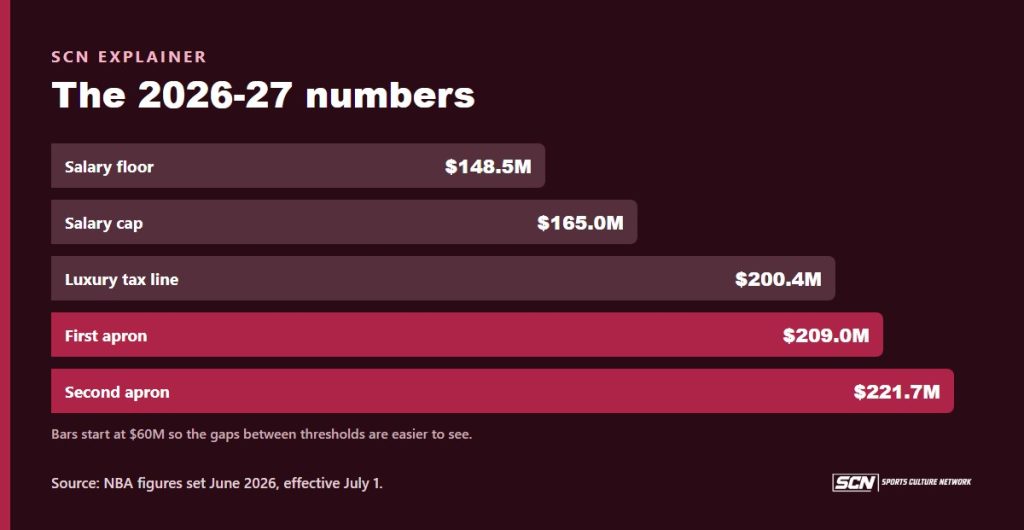
The league sets its figures each June from projected basketball-related income, which players and owners split roughly down the middle, and they take effect when free agency opens on July 1. Alongside this season’s cap of $164.961 million, up from $154.647 million in 2025-26, there is a salary floor of $148.465 million, a luxury tax line of $200.428 million, a first apron at $209.015 million and a second apron at $221.686 million. Under the deal players and owners signed in 2023, the cap cannot jump more than 10% in a year.
Bird rights
The most important exception carries Larry Bird’s name, because the Celtics’ push to re-sign him in the 1980s is where it came from. Bird rights let a team go over the cap to keep its own free agents.
A player who has spent three seasons with a club without changing teams as a free agent or being waived carries full Bird rights. His team can offer him up to the maximum salary for up to five years. Two seasons earns Early Bird rights, which allow a raise to 175% of his previous salary or 105% of the league average, whichever is bigger. After a single season a team holds Non-Bird rights, which allow a 120% raise.
This is why homegrown stars usually stay. Their own team is the only one that can pay them the most money without needing cap space. Bird rights also move with a player when he is traded, so a contender that trades for a star on an expiring contract is buying the right to re-sign him as much as the player himself.
The exceptions that build benches
Teams over the cap fill out their rosters through smaller exceptions. The non-taxpayer mid-level exception, worth roughly 9% of the cap a year, is the big one. It is how a contender adds a proper starter or a sixth man in July. Teams above the first apron get a smaller taxpayer version, and teams that have used their cap space get a small room exception instead. A bi-annual exception can be used every other year by teams under the first apron, and any team can sign players to minimum contracts at any time.
Trades create another tool. When a team sends out more salary than it takes back, it receives a traded player exception that lets it absorb a contract later, within a year.
Paying the tax
Go past the tax line and the bill arrives after the season. The rate rises the further over a team goes, and a franchise that has paid tax in three of the previous four seasons is treated as a repeat offender and charged even more per dollar. The money is shared out among the teams who stayed under the line, so a careful owner in a small market can collect a cheque funded by a rival’s spending spree.
For a long time the tax was the only real brake. If an owner was willing to pay, a superteam could stay together.
The aprons changed everything
The 2023 agreement added two thresholds above the tax line, and rather than costing money they take away the tools a front office uses to improve a roster.
A team over the first apron loses the full mid-level and the bi-annual exceptions. It can no longer take back more salary than it sends out in a trade, cannot receive a player in a sign-and-trade, and cannot sign a bought-out player whose old salary was above the mid-level.
The second apron is where it gets serious. A team above it cannot combine several contracts in one trade to bring back a bigger one, cannot send cash in deals, loses the taxpayer mid-level and cannot use its old trade exceptions. Its first-round pick seven years out is frozen, and a team that stays above the second apron season after season can see a future first-round pick moved to the end of the round.
The effect has been obvious since the rules came in. Champions now break up expensive cores within a year or two, executives talk about “getting under the second apron” as an achievement in itself, and a star’s trade request is often shaped as much by a destination’s apron position as by its chance of winning.
What a max contract is worth
A player’s first-year salary on a new deal is capped at a share of the cap that rises with experience. Players with up to six years in the league can earn 25%, those with seven to nine years 30%, and veterans of ten years or more 35%. At this season’s cap, that is roughly $41.2 million, $49.5 million and $57.7 million in year one.
Annual raises are capped as well, at 8% for a player re-signing with his own club and 5% for one moving teams. Add the fifth year that only the incumbent can offer and staying put is usually worth tens of millions of dollars.
The supermax, officially the Designated Veteran Player Extension, lets a team pay a player with seven to nine years of service 35% of the cap if he meets award criteria such as an All-NBA selection or an MVP. Since 2023 most individual awards come with a 65-game minimum, so a star who misses a chunk of the season can lose eligibility for the biggest contract of his career. A similar provision for players leaving their rookie deals, widely known as the Rose Rule after Derrick Rose, raises their ceiling from 25% to 30% of the cap.
Rookies and two-way players
First-round picks sign on a fixed rookie scale tied to draft position: two guaranteed years and two team options. Teams can offer an extension after year three. Without one, the player becomes a restricted free agent after year four and his club can match any offer sheet he signs elsewhere. Second-round picks negotiate their own deals and often begin on two-way contracts, which let a team carry up to three players who split time with its G League affiliate and do not count against the cap.
Reading the rumours
Once you know the rules, the trade chatter starts to make sense. “Matching salaries” means a team over the cap has to send out roughly what it takes in. A team “hard-capped at the first apron” has used an exception that bars it from crossing that line for the rest of the season. And a champion letting its third-best player walk in free agency is usually not losing faith in him. It is choosing to keep its draft picks and its trade options rather than live above the second apron.
Follow trades, signings and contract news in our NBA coverage, and read how the NBA playoffs and Play-In Tournament work.