In May 2025 the Dallas Mavericks had a 1.8% chance of winning the NBA draft lottery. Three months earlier they had traded Luka Dončić, and their fans were still furious. Then the ping-pong balls came out in their favour, and Dallas used the first pick on Cooper Flagg, the most coveted prospect in years. The result delighted Dallas and baffled almost everyone else. It also arrived in the middle of a long argument about the lottery itself, which the league settled a year later with the biggest change to the draft in decades.
Why a lottery at all?
Most American leagues hand the first draft pick to the worst team. The NBA did too, until it noticed the obvious problem. A single great player can change a basketball team more than in any other sport, so a team that has given up on its season has a reason to lose on purpose. In 1984, the Houston Rockets were widely accused of losing games late in the season to secure the chance to draft Hakeem Olajuwon. A year later the league introduced the lottery.
The first one, in 1985, gave every non-playoff team an equal chance. The New York Knicks won it and took Patrick Ewing, and the theory that commissioner David Stern had a frozen envelope to help the league’s biggest market has been told at bars ever since. In 1990 the NBA moved to a weighted system, giving the worst teams the best odds, and it adjusted the weighting several times after that.
The 2019 to 2026 system
For seven drafts, from 2019 to 2026, the 14 teams that missed the playoffs went into the lottery. The three worst records shared the best odds, 14% each, of winning the first pick, and the odds fell from there. Four picks were drawn by lottery and the rest followed the standings, so the worst team could fall no further than fifth.
The flatter odds were meant to make losing less attractive. They did not stop it. Teams still emptied their rosters in March, shut down healthy players with vague injuries and played rookies 40 minutes a night. The Philadelphia 76ers’ “Process” years in the mid-2010s, when the club lost on purpose for three seasons to stockpile high picks, had become the model, and every few years another franchise tried its own version.
The 3-2-1 lottery
On May 28, 2026, the NBA’s Board of Governors voted 29-1 for a new system, with the Memphis Grizzlies the only team against. It starts with the 2027 draft and runs through 2029, after which the owners must vote again to keep it or replace it.
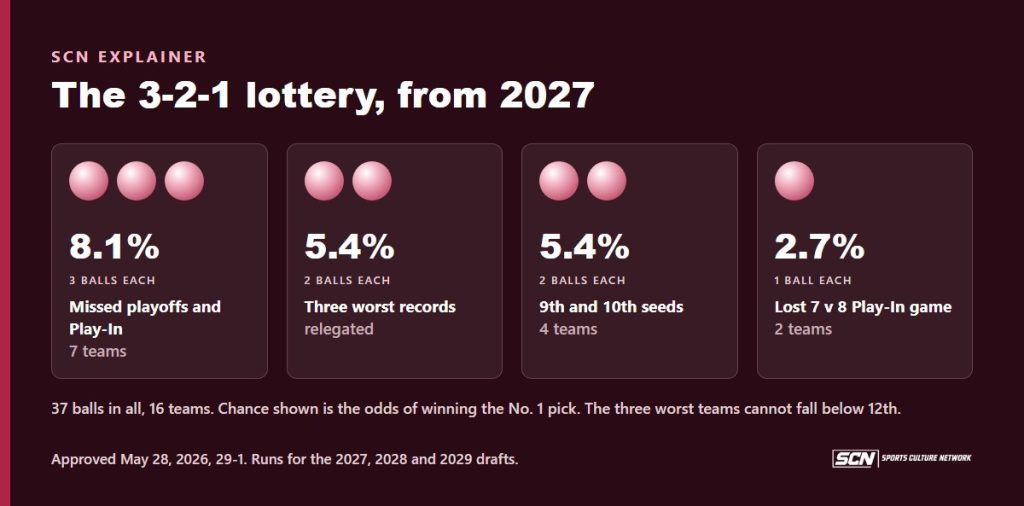
The lottery grows from 14 teams to 16: the ten teams that miss both the playoffs and the Play-In, the four teams that finish ninth and tenth in their conferences, and the two teams that lose the seven-versus-eight Play-In games, whether or not they go on to claim the No. 8 seed. Instead of percentages tied to the standings, each team gets a number of balls in the draw:
- Teams that missed the playoffs and the Play-In get three balls each, an 8.1% chance at the first pick.
- The three worst teams in the league are “relegated” and get only two balls, a 5.4% chance.
- Teams that finished ninth and tenth in their conference get two balls, also 5.4%.
- The two teams that lost the seven-versus-eight Play-In games get one ball, 2.7%.
That adds up to 37 balls. The lottery now decides the order of the first 16 picks. The three worst teams have a safety net: they cannot fall below the 12th pick, while other lottery teams can drop as far as 16th.
The league also gave the commissioner wider powers to punish teams caught tanking, including reducing their lottery odds or moving their draft position.
What it changes
The point of the reform is simple. Finishing with the worst record in the league no longer gives a team the best chance at the top pick. It gives a slightly worse one than the teams just above it in the standings. The thinking is that no front office will lose 65 games on purpose to end up with lower odds than a team that tried and fell short.
Critics say it punishes teams that are genuinely bad rather than tanking, and that a rebuilding club with a terrible roster now has less hope of landing a franchise player. The guarantee that the worst three cannot fall past 12th was added to soften that. Others argue that teams will now chase the middle of the table in March, aiming for one of the three-ball spots rather than the bottom. Memphis, which voted against, argued that small-market teams rely on the draft more than anyone.
Supporters point to the late-season games the old system ruined. In recent years, March basketball featured several teams openly not trying to win, which hurt ticket sales and television ratings, and annoyed fans who had paid to watch.
How the night works
The lottery itself is held in a private room in May, a few weeks before the draft, with team representatives, accountants and members of the media present as witnesses. Fourteen numbered balls are placed in a machine, four are drawn to make a combination, and each combination is assigned in advance to a team according to its odds. The televised show that follows reveals the results in reverse order, with team executives sitting on stage holding lucky charms. Under the new format the number of combinations and draws changes, but the principle of weighted chances, witnesses and a sealed room stays the same.
Traded picks add another layer. Many first-round picks are protected, meaning they only change hands if they fall outside a certain range. A pick that is “top-four protected” stays with the original team if it lands in the top four, which is why fans of teams with no stake in the lottery still watch to see who owes what to whom. The new 16-team format will make some of those protections behave differently, and teams have had to review the deals they already have on the books.
The lucky ones
Lottery history is full of long shots. Orlando won it in 1993 with a 1.5% chance, the lowest odds ever to land first, a year after already winning it and taking Shaquille O’Neal. Chicago jumped from ninth to first in 2008 and drafted Derrick Rose from their own city. Cleveland won three times in four years between 2011 and 2014. Dallas’s 2025 win, with odds of 1.8%, came from the 11th-best position, matching Orlando’s record jump from 1993.
Under the 3-2-1 system, a team with an 8.1% chance is the favourite. Expect more nights like those.
Follow the race, the trades and the draft in our NBA coverage. For how those rookies are paid, read how the NBA salary cap works, and for the Play-In that now feeds the lottery, see how the NBA playoffs and Play-In work.