In April 2023 the Miami Heat lost their first Play-In game at home to Atlanta and were one defeat from going home. Two nights later they beat Chicago to claim the East’s last playoff place, then knocked out the top-seeded Milwaukee Bucks, beat the Knicks and the Celtics and reached the NBA Finals. A team that finished the regular season seventh in its conference played for the title.
That run is the strongest argument the league has for its Play-In Tournament, and a good way into how the NBA postseason works.

Six in, four fighting
The NBA has 30 teams, 15 in each conference. After an 82-game regular season, the top six in the East and the top six in the West go straight into the playoffs. Teams finishing seventh to tenth go into the Play-In Tournament, which decides the seventh and eighth seeds. Everyone else starts their summer.
Division titles still exist but no longer earn a guaranteed place or a high seed. Since 2016, seeding has been decided purely by record inside each conference.
How the Play-In works
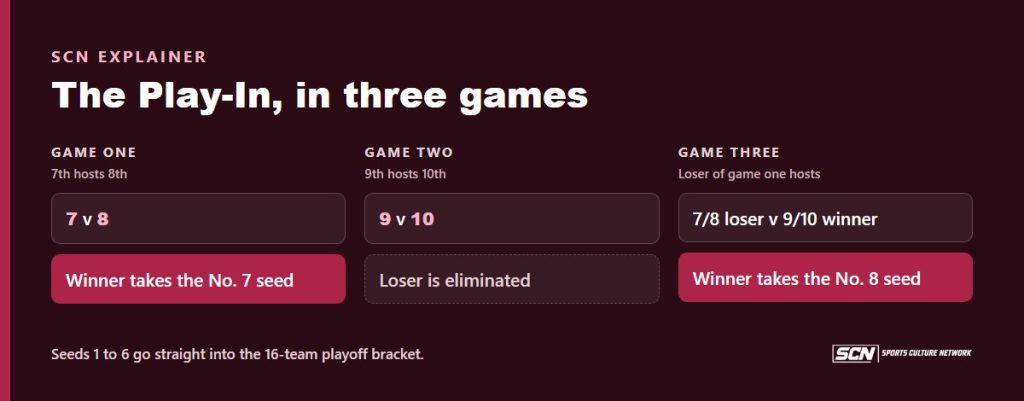
Each conference’s Play-In has three games over a few days in mid-April. The seventh seed hosts the eighth, and the winner takes the No. 7 seed. The ninth hosts the tenth, and the loser of that game is out. Then the loser of the seven-versus-eight game hosts the winner of nine-versus-ten for the No. 8 seed.
So the seventh and eighth-placed teams get two chances to win one game, while the ninth and tenth need to win twice on the road or at home against a better team. It rewards finishing seventh over tenth without making the regular season pointless.
The format began in the 2020-21 season, after a one-off version in the 2020 Orlando bubble. Some coaches and players disliked it at first, mostly the ones who finished seventh and had to play their way in. It survived because it kept a dozen more teams interested in the last month of the season and gave the league a few extra nights of win-or-go-home basketball.
Best of seven, four rounds
Once the 16-team bracket is set, every round is a best-of-seven series. The first team to four wins advances. The bracket is fixed and stays inside each conference until the Finals: the No. 1 seed plays the No. 8, the No. 4 plays the No. 5, the No. 3 plays the No. 6 and the No. 2 plays the No. 7. The 1-8 winner meets the 4-5 winner in the conference semifinals and the 2-7 winner meets the 3-6 winner. There is no reseeding.
The conference finals produce the Eastern and Western champions, who meet in the NBA Finals. The full playoffs take about two months, from mid-April to mid-June.
Home court
The team with the better record hosts Games 1, 2, 5 and 7. The other team is at home for Games 3, 4 and 6. This 2-2-1-1-1 pattern is used in every round, including the Finals, which used a 2-3-2 format from 1985 to 2013 to cut down on cross-country travel.
In the Finals, home court goes to the team with the better regular-season record regardless of conference. Home advantage matters more in basketball than in most sports, and Game 7 is where it is felt most. Home teams have won the large majority of Game 7s in NBA history.
Breaking ties
When two teams finish with the same record, the first tiebreaker is their head-to-head record. If that is level, a division winner gets the edge over a team that did not win its division, then it goes to winning percentage within the division if the teams share one, then conference record, then record against playoff teams in their own conference and against playoff teams in the other. Point differential is the last resort before a random drawing. Ties involving more than two teams use a slightly different order, and division winners are again favoured early on.
The 65-game rule and the race for seeds
The 2023 labour agreement made most individual awards, including MVP and All-NBA, conditional on a player appearing in at least 65 games. It was aimed at load management, the habit of resting healthy stars, which had become a sore point with broadcasters and fans who bought tickets to see them. It also changed late-season behaviour. Stars now have a reason to play in March, and a team chasing the sixth seed to avoid the Play-In usually has its best players available.
The fight for the top six is often fiercer than the fight for first. A team that slips to seventh risks being knocked out in a single game, and the difference between first and second is mostly about home court in a series that may never happen.
The NBA Cup
Since 2023 the regular season has also included an in-season tournament, the Emirates NBA Cup. Group games are played as normal regular-season fixtures in November, and eight teams reach a knockout stage in December. From the 2026-27 season the semifinals are hosted by the higher-seeded team rather than at a neutral site, and the final remains in Las Vegas. The final does not count in the standings, and the Cup has no bearing on playoff seeding, but the prize money matters to players on smaller contracts.
When the eighth seed bites
Eighth seeds beating top seeds remains rare, which is why each one is remembered. Dikembe Mutombo lay on the floor clutching the ball after Denver beat Seattle in 1994. The “We Believe” Warriors knocked out a 67-win Dallas team in 2007. Memphis beat San Antonio in 2011, Philadelphia beat Chicago in 2012 after Derrick Rose tore his ACL, and the 2023 Heat beat a Milwaukee team that had won 58 games. In 2023 the Los Angeles Lakers, also through the Play-In, reached the Western Conference finals as a seventh seed.
Over two months and as many as 28 games, the better team usually wins. That is the case for best-of-seven. The Play-In added a single-game shock at the start of it.
Follow every series in our NBA coverage, and read how the NBA salary cap works to see why so many of those rosters are built the way they are.