For 135 games, no No. 16 seed had beaten a No. 1. Then on a Friday night in Charlotte in March 2018, UMBC, a commuter school from outside Baltimore, beat Virginia by 20 points. Five years later Fairleigh Dickinson, one of the shortest teams in Division I, knocked out Purdue and its 7-foot-4 centre Zach Edey. Moments like those are why tens of millions of Americans fill out a bracket every spring, and why March is the busiest month on the college basketball calendar.
Getting in
The men’s NCAA tournament has 68 teams. Every Division I conference sends its champion, which in almost every league means the winner of a conference tournament played in the first two weeks of March. Those automatic bids make up roughly half the field. A team from a small conference that has an average season and then wins three games in four days can play in the same tournament as Duke and Kansas. That stretch is known as Championship Week, and for many of those schools it is the only route in.

The rest of the places are at-large bids, picked by a selection committee of athletic directors and conference commissioners. They lean on the NCAA’s NET rankings and a “quadrant” system that sorts every win and loss by the quality and location of the opponent. A road win against a top-30 team is a Quadrant 1 win. A home loss to a team ranked 200th is a Quadrant 4 loss, and a couple of those can sink a résumé. The committee also looks at strength of schedule, road and neutral-site results and a range of computer metrics.
The bracket is revealed on Selection Sunday, the day after the last conference finals. Teams on the edge of the field, known as “bubble” teams, watch the announcement with television cameras pointed at their faces.
Regions, seeds and the bracket
The 64 teams in the main bracket are split into four regions of 16, each named after a part of the country (East, West, South and Midwest). Inside each region, teams are seeded one to sixteen. The committee also ranks the four No. 1 seeds against each other, which decides how they would meet in the Final Four.
First-round games pair seeds that add up to 17: the No. 1 plays the No. 16, the No. 2 plays the No. 15, and so on down to No. 8 against No. 9. The bracket is fixed. If the favourites win, the No. 1 seed meets the 8-9 winner next, then the No. 4 or 5 seed, then the No. 2 or 3.
Before the 64-team bracket begins, the First Four in Dayton, Ohio, narrows 68 teams to 64. Two games are between the four lowest-ranked at-large teams and two between the four lowest-ranked automatic qualifiers, with the winners going into the bracket as 11 or 16 seeds.
The names of the rounds
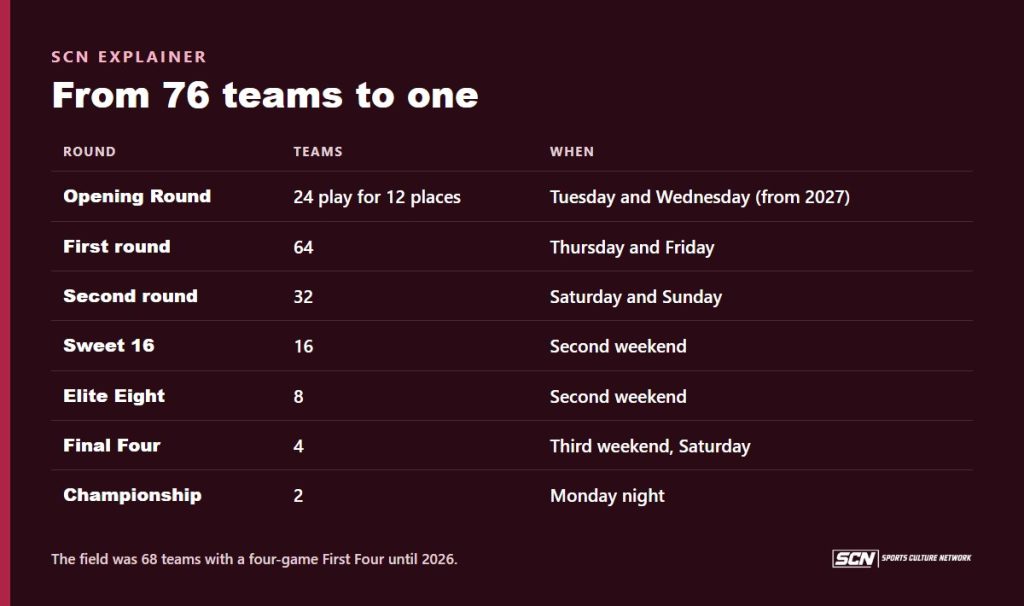
The tournament runs over three weekends. The first and second rounds, cut from 64 teams to 32 and then to 16, are played on the Thursday to Sunday after Selection Sunday at eight sites around the country. The 16 teams left make up the Sweet 16. Wins in the regional semi-finals and finals the following weekend produce the Elite Eight and then four regional champions.
Those four go to the Final Four, held in an NFL stadium the next weekend, with the semi-finals on Saturday and the national championship on Monday night. After the final, CBS plays “One Shining Moment”, a montage set to a song written for the tournament in 1986. It has become as much a part of the event as cutting down the nets.
What the seeds really mean
Higher seeds win most of the time, but the size of the gap matters. Through the 2025 tournament, No. 1 seeds had lost to No. 16s only twice in 40 years of the 64-team format. No. 12 seeds are a different story. They beat No. 5s often enough that picking at least one 12-5 upset has become a bracket tradition, and the No. 8 against No. 9 game is close to a coin toss.
Deep runs by low seeds are rare and remembered. Saint Peter’s, a 15 seed from Jersey City, reached the Elite Eight in 2022. Loyola Chicago reached the Final Four as an 11 seed in 2018, with its 98-year-old chaplain, Sister Jean, at every game. On the other hand, all four No. 1 seeds reached the Final Four only twice in that span, in 2008 and 2025.
Why the bracket is so hard
A perfect bracket means calling 63 games in a row correctly. Even someone who picked every game with very good information would face odds in the hundreds of billions to one, and no verified perfect bracket has ever been recorded in a major online contest. Most entries are ruined by the end of the first weekend. That is part of the appeal. A fan who has not watched a game all season can beat a college basketball analyst by picking teams by mascot.
76 teams from 2027
The tournament is about to get bigger. In May 2026 the NCAA approved expanding both the men’s and women’s tournaments from 68 to 76 teams, starting with the 2027 tournament. It is the largest change to the field since it grew from 53 to 64 teams in 1985.
The First Four becomes the Opening Round, with 24 teams instead of eight: the 12 lowest-seeded automatic qualifiers and the 12 lowest-seeded at-large teams, playing 12 games for places in the 64-team bracket. Dayton keeps its role, and a second site will share the games. For 2027, Selection Sunday is March 14 and the Opening Round games are on March 16 and 17.
The NCAA says expansion will bring more than $131 million in extra payments to schools over the remaining years of its television deal. It also means more at-large places for teams from the biggest conferences. Critics, including UConn coach Dan Hurley, have argued it risks making the regular season less meaningful. Supporters say more teams get a shot at a March moment. Either way, from 2027 the bracket starts with a longer first week.
The women’s tournament
The women’s tournament follows the same structure and is expanding to 76 teams on the same timetable. Its popularity has grown fast in recent years. The 2024 final, in which South Carolina completed an unbeaten season against Caitlin Clark’s Iowa, drew a bigger television audience than the men’s final, a first for the event.
Follow the bracket, the bubble and the upsets in our college basketball coverage. For the pro game, read how the NBA playoffs work.