For more than a century, college football handed out national championships by vote. Sportswriters and coaches ranked the teams after the bowl games, and in years when two unbeaten teams never met, the sport simply had two champions. In 1997 Michigan won the AP title and Nebraska took the coaches’ version. Fans argued about it for decades.
The College Football Playoff was built to end that. It started in 2014 with four teams, grew to 12 for the 2024 season, and stays at 12 in 2026 after the sport’s two most powerful conferences failed to agree on how much bigger it should get.
Who gets in
Realignment has left four conferences at the top of the sport: the SEC, the Big Ten, the Big 12 and the ACC, known together as the Power Four. Below them sit the American, the Mountain West, the Sun Belt, Conference USA and the Mid-American, often called the Group of Five. Notre Dame stays independent in football, as it always has.
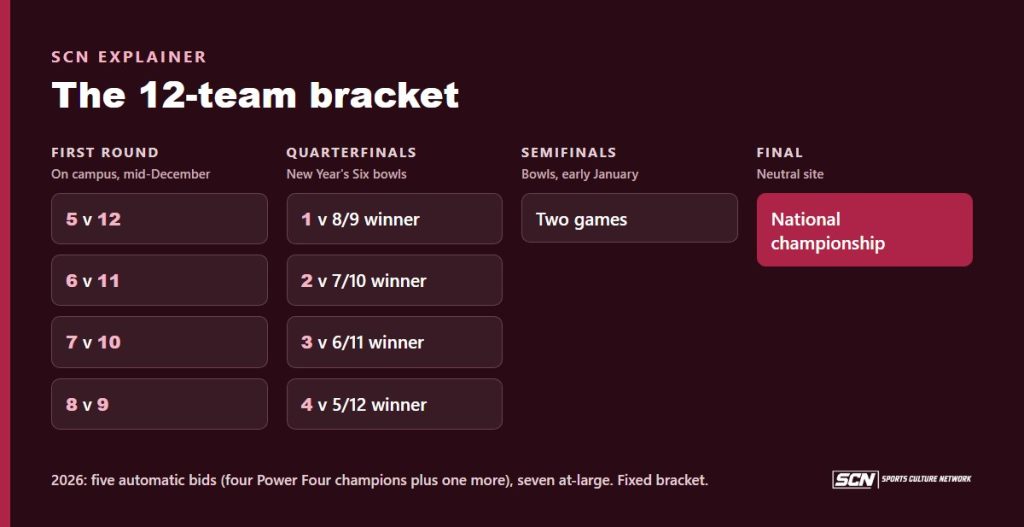
For 2026, the champion of each Power Four league is guaranteed a place, wherever it ends up in the rankings. The highest-ranked champion from the other conferences gets the fifth automatic bid. The remaining seven places go to the highest-ranked teams left in the committee’s final top 25. Notre Dame is in if it finishes inside the top 12.
Conference championship games on the first weekend of December decide those automatic bids, which turns that Saturday into a play-in round. An underdog that wins its title game can knock an at-large hopeful out of the field without ever playing it.
The committee
There is no formula. A selection committee of about a dozen people, mostly athletic directors with a few former coaches, players and administrators, meets in person through the second half of the season and argues it out. Its first top 25 comes out in late October and it updates the list every week. The final ranking is released on the Sunday after championship weekend, and that ranking is the bracket.
Members are told to look at conference titles, strength of schedule, head-to-head results and results against common opponents. They leave the room when a school they are connected to is being discussed. They do not publish their votes, and every December at least one fan base is sure it has been robbed.
Seeding
The first 12-team season held the top four seeds, and the first-round byes that come with them, for the four highest-ranked conference champions. It led to some strange results. Arizona State and Boise State got byes in 2024 while higher-ranked teams such as Texas and Penn State had to play an extra game.
From 2025 the playoff moved to straight seeding. The committee ranks the 12 teams and they are seeded in that order. A conference champion is guaranteed a place but not a week off. Once the bracket is set it stays set, with no reseeding between rounds.
December on campus
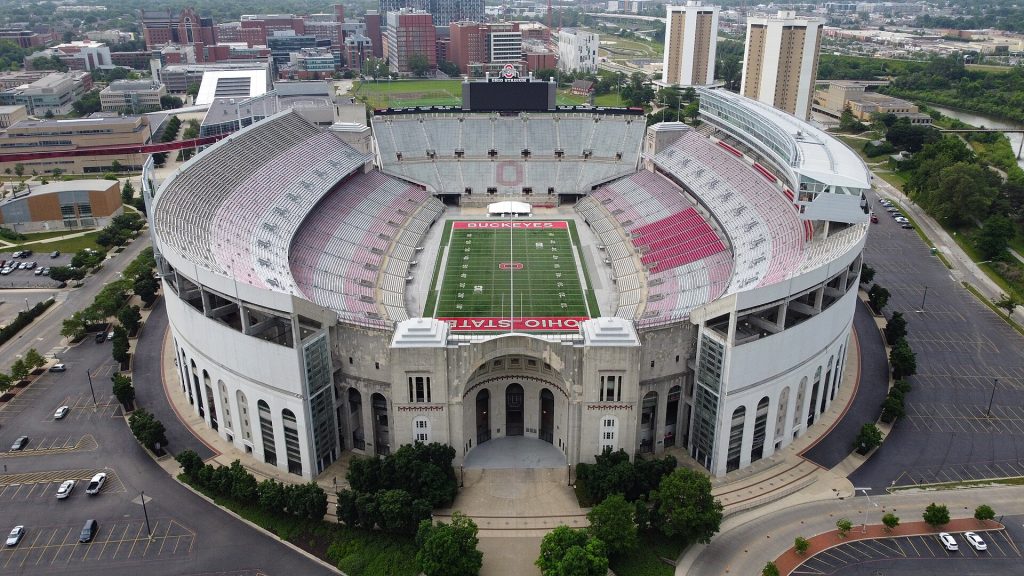
The first round is played at the home stadium of the higher seed, with No. 5 hosting No. 12, No. 6 against No. 11, No. 7 against No. 10 and No. 8 against No. 9. Those games, in front of student sections in Columbus or South Bend or State College in the cold, were the best thing about expansion. College football had never had playoff games on campus before.
The quarterfinals and semifinals move to six bowls that rotate the hosting duties: the Rose, Sugar, Orange, Cotton, Fiesta and Peach. Four of them stage quarterfinals around New Year’s Day and the other two hold the semifinals in early January. Higher seeds get first call on bowl sites, and from 2026 the old conference tie-ins, such as the Rose Bowl’s century-long link to the Big Ten, no longer decide who goes where. The two semifinal winners meet in the national championship game at a neutral stadium in mid to late January.
From polls to a bracket
The sport’s first attempt at settling things on the field was the Bowl Championship Series, which ran from 1998 to 2013 and used polls and computer ratings to put two teams in a title game. It removed split titles but not the arguments, because a third unbeaten team was often left out. The four-team playoff that replaced it was dominated by a handful of programmes. Alabama, Clemson, Georgia and Ohio State took most of the titles.
The 12-team field was agreed in 2022 and first played in the 2024 season. Ohio State, the No. 8 seed, won four games, the first of them at home against Tennessee, to take the title. It showed that a team without a bye could win it all.
What happens next
The format beyond 2026 is not settled. The Big Ten has pushed for a much bigger field with several guaranteed places for each of the largest conferences. Others prefer 16 teams with more at-large spots. Under the current deal the SEC and Big Ten effectively control any change, and when they could not agree last winter, the decision was pushed back a year.
Meanwhile the rest of the bowl schedule carries on. Dozens of games still reward teams outside the playoff with a trip in December, and for many programmes a bowl win remains the high point of the year. None of those games affects the title race.
Follow the rankings and the playoff race in our college football coverage. For the next step for the stars of the college game, see how the NFL Draft works, or read how the NFL playoffs work.