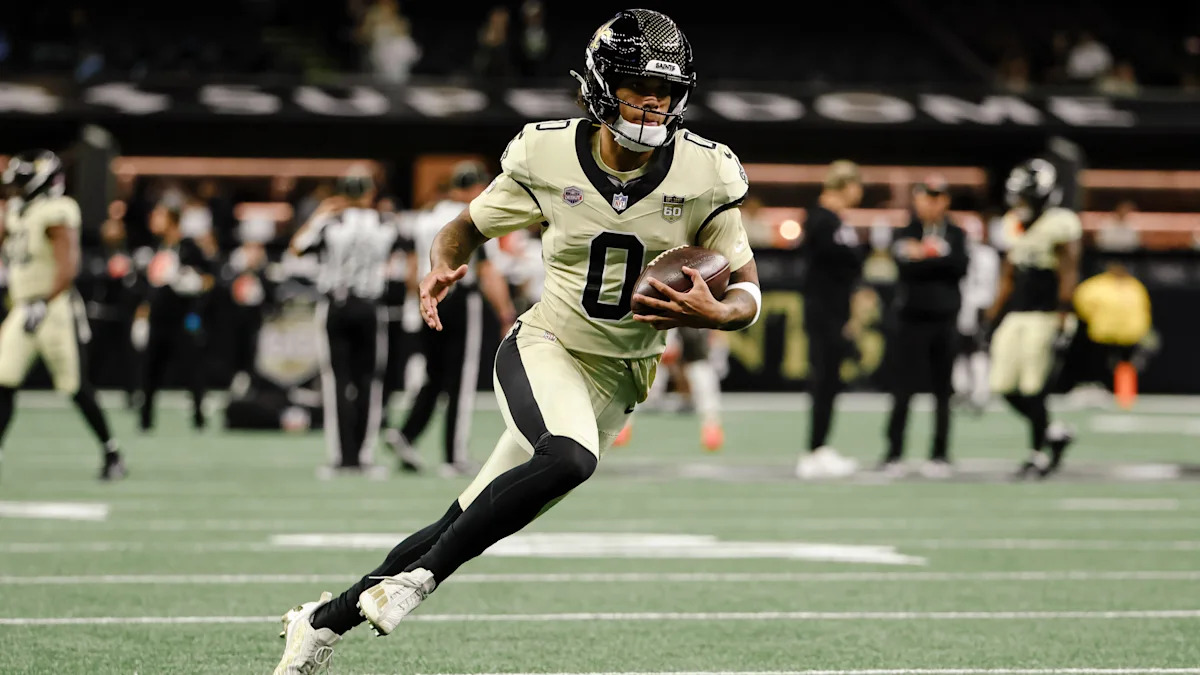
Jordyn Tyson commanded 31 percent of his routes with targets during his limited New Orleans debut, despite running only 16 routes. The rookie top-10 draft pick caught five passes, the second-most on the Saints behind Chris Olave, who led the team in targets. Devaughn Vele, the Saints’ WR2 at the start of the season, was targeted only four times on 44 routes, showing a stark contrast in usage.
Tyson’s day began with a fumble but he rebounded with three receptions in the fourth quarter as New Orleans mounted a comeback to force overtime. He was primarily used in the slot and on the move, mirroring Vele’s role before his production waned. Tyler Shough ranks third among NFL quarterbacks in completions, and while Olave remains the No. 1 receiver, Tyson’s volume suggests he could carve out a significant role going forward.
Meanwhile, Jonah Coleman dominated touches for the Denver Broncos, accounting for 80.8 percent of the team’s running back snaps. This is the second-highest share since Sean Payton took over the Broncos in 2023. Payton’s backfield strategy typically involves committees, as seen in Denver and previously in New Orleans with Alvin Kamara and Mark Ingram. Coleman’s clear majority usage is unusual and notable, especially for a rookie.
Since the second quarter of Week 8, Coleman has been the primary option for carries, receiving, and red-zone touches. RJ Harvey posted RB1-level numbers in a similar role last season after an injury to J.K. Dobbins. Harvey is expected to return eventually, but for now Coleman is the short-term lead back and should see the lion’s share of red-zone opportunities. His current workload places him among fantasy football’s more valuable running backs.
On the other side of the NFL, Breece Hall returned to the New York Jets with 64.3 percent of the running back touches, his lowest percentage this season. This split with Braelon Allen complicates Hall’s fantasy outlook. Allen’s receiving role and route participation doubled Hall’s on Sunday, limiting Hall’s ceiling. Hall’s previous fantasy success was boosted by his receiving ability, which now faces stiff competition.
A fumble by Allen did not reduce his playing time during the game. Hall’s future value hinges on regaining a more dominant role in the Jets’ backfield. If Allen maintains this level of involvement, Hall’s fantasy production may be constrained.
Nico Collins’s target share with the Houston Texans has fallen to 16.2 percent since Week 5. Despite scoring over 15 PPR points in Week 9, Collins accounted for only 17 percent of Houston’s receiving points in a game where C.J. Stroud threw for 384 yards and five touchdowns. His 10.8 percent target share in Week 9 is particularly concerning given the absence of Jaylin Noel, who joined Jayden Higgins on the injured list.
With two of Houston’s top wide receivers sidelined, Collins has not been able to separate from other options in terms of volume. Stroud’s strong performance keeps Collins’s overall fantasy value intact but introduces more risk for low-output weeks, as was evident in Week 8.
Jonathan Taylor’s touchdown production for Indianapolis has dropped to 1.4 per game since Week 5, above only the Los Angeles Chargers. Once a first-round fantasy pick, Taylor’s volume and efficiency have declined amid a five-game losing streak for the Colts. His share of running back touches has decreased from 85 percent early in the season to 63 percent over the last three weeks.
Taylor remains the primary red-zone option but has fallen from RB2 status in that area last season to 16th this year. The Colts’ offensive struggles and weakening offensive line offer little hope for a rebound in Taylor’s production. His fantasy outlook now sits at around an average RB2 level.
Bucky Irving has posted 21 touches per game this season, ranking fifth among running backs. His recent 24-touch game in Chicago extended his streak of 20-plus touch performances to five games. Irving has become the focal point of the Tampa Bay offense, handling the ball on 58.4 percent of his snaps.
With Baker Mayfield at quarterback, Irving receives a high percentage of run-game opportunities and targets, being thrown to on 27 percent of his routes. While Kenny Gainwell may take some snaps, Irving’s workload remains substantial. Tampa Bay’s offensive line and Irving’s health have supported a rushing attack that has proven effective even against strong rushing defenses like the Bears.
Joe Milton completed only 38.3 percent of his passes in his first start of the season for the Philadelphia Eagles. On 47 dropbacks, Milton connected on just 18 passes. This low completion rate has raised concerns about the Eagles’ offensive production, especially for players like Makai Lemon and Dallas Goedert, who rely on consistent quarterback play to reach double-digit fantasy points.
According to Yahoo Sports.