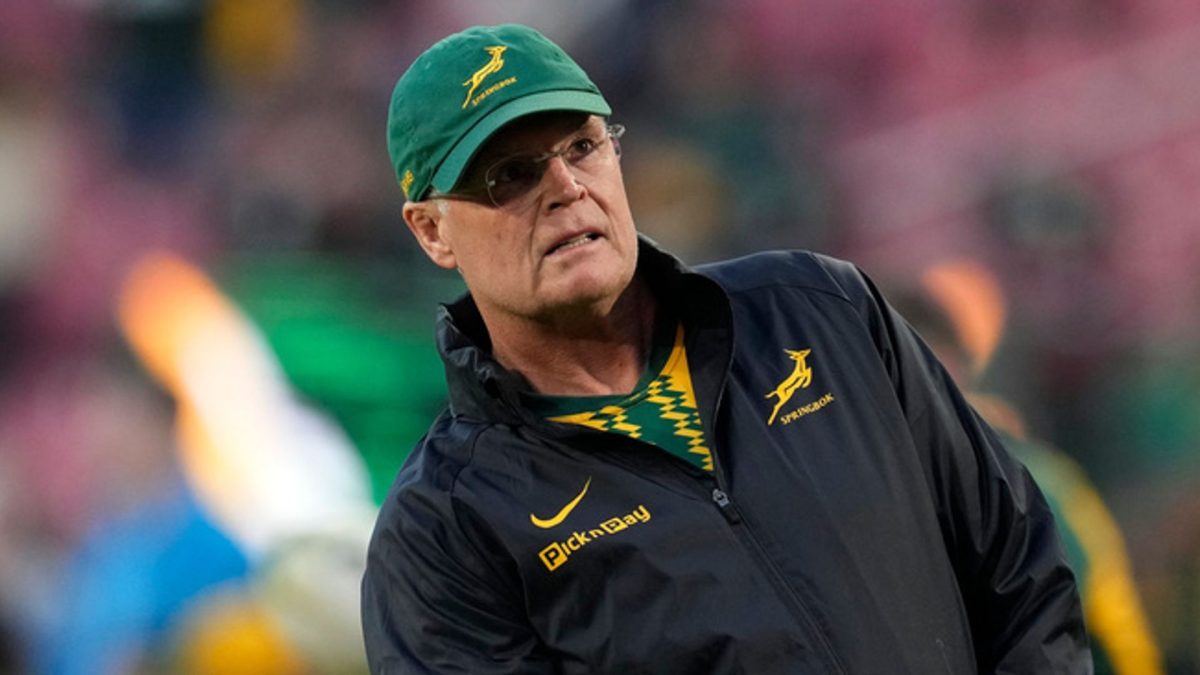
South Africa Rugby has condemned threats and abusive conduct aimed at World Rugby officials following the six-match ban imposed on Springboks head coach Rassie Erasmus. The suspension came after an independent panel reviewed Erasmus’s comments at a press conference on 16 November, where he accused match officials of missing 17 illegal tackles in South Africa’s Nations Championship defeat to France.
Erasmus suggested that “match-fixing” and “manipulation” influenced the outcome of the game, remarks that led World Rugby to activate its Match Official Abuse Sanction Process. The framework, introduced in July, seeks to address and penalise misconduct directed at referees and match administrators. As a result, Erasmus will be barred from any matchday involvement in international fixtures for six Tests.
South Africa Rugby has formally requested a full misconduct hearing for Erasmus. Meanwhile, the governing body has spoken out against the wave of online abuse targeting World Rugby officials in the wake of the ban.
“SA Rugby is aware of the extensive public commentary, analysis and debate surrounding recent matters involving Springbok head coach Rassie Erasmus and World Rugby,” the organisation said in a statement released on Wednesday.
The statement warned about the volume of commentary, including AI-generated content, circulating publicly that does not always reflect the facts or the correct context of the processes involved.
“What is deeply concerning, however, is the reaction of some individuals on social media and other platforms, particularly reports of threats and abusive conduct directed at World Rugby officials and administrators,” SA Rugby said.
The organisation condemned all forms of intimidation, threats, and personal attacks. “Such behaviour has no place in rugby and is entirely contrary to the values upon which our game is founded,” the statement added.
Rugby is cited as a sport built on respect, discipline, integrity, and sportsmanship. SA Rugby emphasised that these principles extend beyond the pitch to everyone involved, including players, coaches, match officials, administrators, and supporters.
The statement also reassured stakeholders that rugby has the expertise, experience, and governance structures necessary to address these matters appropriately. “Any issues that arise will be addressed through the established rugby processes and by the individuals entrusted with these responsibilities, ensuring that due process is followed and that the best interests of the game remain paramount.”
Erasmus’s comments came after South Africa’s 29-27 loss to France on 13 November in the Nations Championship, a competition involving some of Europe’s top international teams. His press conference on 16 November at the Aviva Stadium, ahead of the match against Ireland, was described by World Rugby as “outspoken,” leading to a swift review of his remarks.
World Rugby confirmed it had imposed the sanction following the panel’s decision under the new abuse sanction process. The ban means Erasmus cannot coach or participate in matchday activities for the next six international games, a significant absence for the Springboks.
SA Rugby’s call for calm insists that open debate and differences of opinion must always be expressed respectfully. The organisation underlined its commitment to protecting the integrity of rugby and maintaining respectful treatment of all participants.
The full misconduct hearing requested by SA Rugby is expected to provide a further forum for Erasmus to respond to the allegations and for the matter to be resolved within World Rugby’s disciplinary framework. No date for the hearing has been announced.
According to Sky Sports.