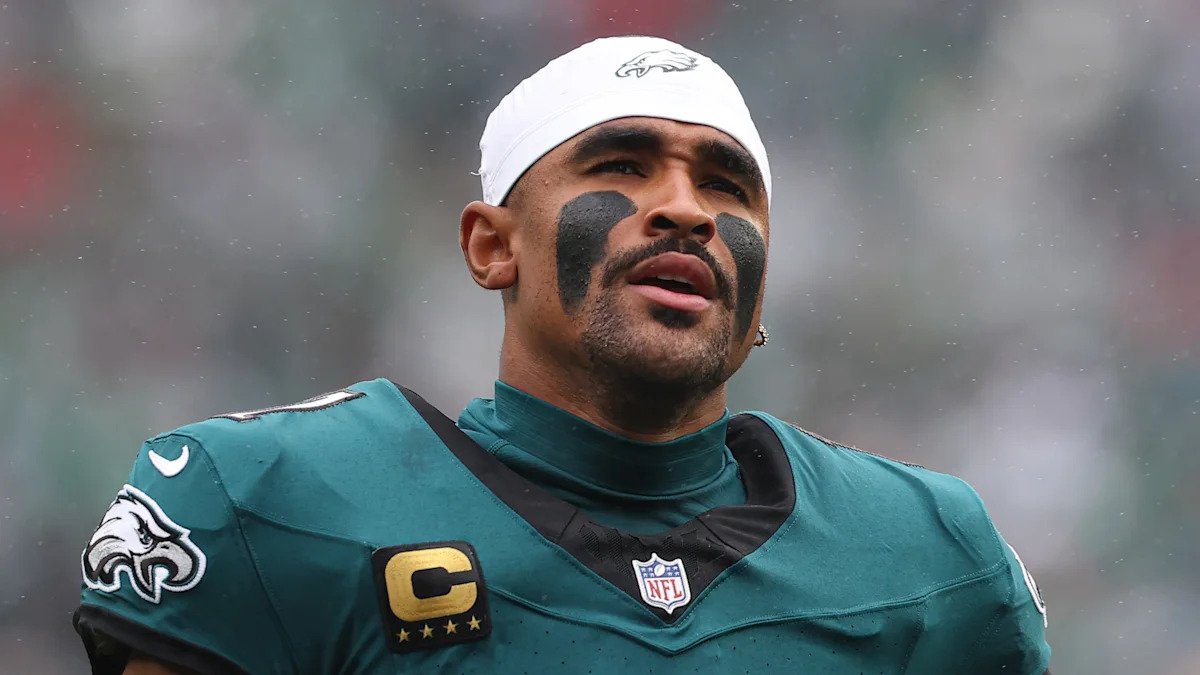
The NFL has firmly rejected suggestions that football considerations influenced the Philadelphia Eagles’ medical decisions regarding Jalen Hurts after his blood clot condition worsened. The league’s chief medical officer, Allen Sills, said on Tuesday, “There is no doctor who is taking orders from a football person, a non-medical person, period.” Sills and NFL executive vice president Jeff Miller defended the team’s medical staff against criticism following Hurts’ diagnosis and subsequent treatment.
Hurts was first diagnosed on October 10 with a superficial blood clot in his calf. Despite the diagnosis, he played the next day against the Jacksonville Jaguars in London. Later imaging revealed the clot had progressed into the deep veins of his calf and into both lungs. The Eagles placed Hurts on injured reserve as he began blood thinner treatment.
Questions arose about the safety of Hurts playing and traveling more than seven hours across the Atlantic with the clot. Miller dismissed criticism aimed at the Eagles’ doctors as “unfounded.” Sills explained that disease progression can happen even when all proper medical steps are taken. “Sometimes in medicine, we do all the right things and diseases progress and other things develop,” he said, adding that the medical staff was “incredibly conservative and incredibly vigilant.”
Sills noted that the swift diagnosis of Hurts’ condition reflected thorough medical care that might not have occurred for a non-athlete, saying, “Quite frankly, you or I probably would have walked around a lot longer without a diagnosis.” He gave a nearly five-minute statement defending the league and Eagles’ protocols, calling some reports “nonsense” and insisting player health was paramount.
When asked if the league would investigate the Eagles’ handling of Hurts’ medical care, Miller indicated they had gathered sufficient information. “Talking to the Eagles staff and making sure from people on the ground, tracking the case, talking to the independent hospital and doctors involved that we have, I think, a complete understanding of the course of events,” he said.
The NFL Players Association responded with a call for transparency. The union said Tuesday evening that it was unaware of any NFL investigation into Hurts’ care and that the league had previously told them it did not plan to review the treatment. “Before conclusions are drawn about how this situation was handled, there must be a full investigation into what occurred,” the NFLPA said. “Determining the facts is essential to ensuring players receive the highest level of care and protection going forward.”
Playing overseas adds medical challenges, especially with travel. Sills described the league’s preparations for international games, including multiple visits to markets years in advance, setting up partnerships with local hospitals and physicians experienced with professional athletes, and conducting emergency training. He emphasized that team doctors also assess players’ readiness to fly home after injury or illness, saying, “You’re always thinking about the implications of flights … [and] the medical implications of travel.”
Hurts’ initial diagnosis came after an 8 p.m. team meeting on October 10, when he went to the Cleveland Clinic in London for imaging. He returned to his hotel at 2:45 a.m., slept until 10 a.m., and then went to the stadium on game day, where he rested rather than participating in pregame warmups. Hurts completed 21 of 40 passes for 220 yards and a touchdown, taking one sack and rushing twice for two yards. The Jaguars won 19-17 after a kickoff return set up a late field goal.
The Cleveland Clinic professionals diagnosed the clot as superficial, meaning it was near the skin and above the fascia layer. They recommended imaging 72 hours later. Subsequent scans showed the clot had spread into deeper veins and the lungs. Two independent medical experts described this progression as “rare” and “unusual.” Dr. Ben Levine and Dr. Thomas Maldonado told Yahoo Sports that a superficial clot typically does not require removal from contact sports, but blood-thinning treatment does. That treatment usually lasts three to six months.
The Eagles said Hurts is expected to make a full recovery and return to contact sports after finishing blood thinner treatment. In a joint statement with Hurts’ agent, Nicole Lynn, the team said, “We anticipate that he will have no long-term effects.”
Sills spoke broadly about the league’s medical environment while respecting patient privacy. He said the Eagles and consulting doctors acted with “a high degree of suspicion to try to identify and take care of these things as quickly as possible.” He added that physicians prioritised Hurts’ health throughout. “Our first obligation as team physicians is always and evermore will be to the patient to do the right thing,” Sills said.
According to Yahoo Sports.