
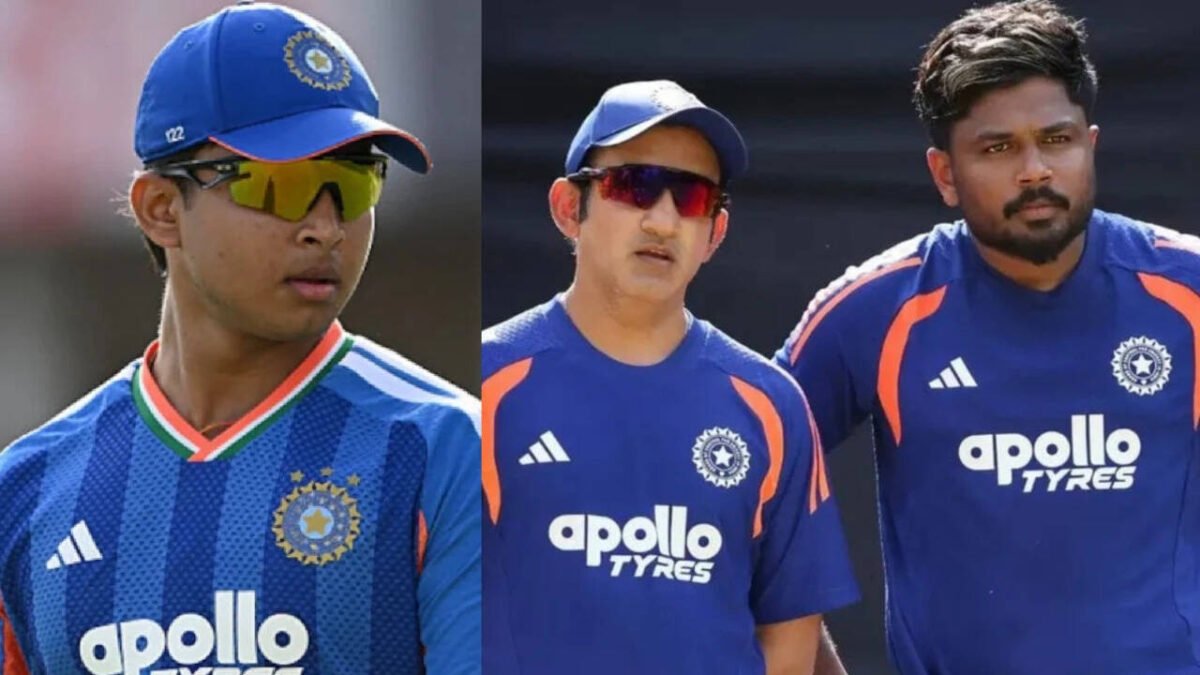
India head coach Gautam Gambhir revealed that dropping Sanju Samson during the T20 series in England was the most difficult decision he has faced in his coaching career. Samson, who was named Player of the Tournament at the T20 World Cup earlier this year, was left out after the opening loss in the five-match series. Gambhir said the choice caused him sleepless nights, given Samson’s importance to the team and the circumstances around Vaibhav Sooryavanshi’s form.
Speaking to JioStar before India’s home series against the West Indies, Gambhir said, “In two years of my journey, that was the only night I could not sleep and I told this to Sanju because I knew that it was probably the toughest decision in my coaching tenure in a T20 format because someone who was player of the tournament, and then you have to leave him out after three or four games.” He added that Sooryavanshi’s form and the need to win the series forced the decision.
Vaibhav Sooryavanshi made his T20I debut in Manchester, replacing Samson in the lineup after India lost the first match. Gambhir explained that Sooryavanshi was “in that kind of form” and the team required a strong start from the top order. “We needed someone to score runs at the top, we needed that little bit of a platform at the top as well. And he was fine with it. And that’s a conversation which me and Sanju had, and he took it in good spirits,” Gambhir said.
The decision was reversed when India returned home for a three-match T20I series against Afghanistan. Samson was reinstated in the playing XI at Sooryavanshi’s expense and responded with back-to-back fifties as India secured a 3-0 series sweep.
Gambhir also addressed the challenges players face in securing a spot in India’s XI, even when in good form. He told Samson that “sometimes with the players who have done well for a long time, you will have to wait for your opportunity.” He emphasised that decisions are based on what the coach and captain believe will win matches, not on outside noise or social media.
“There’s one more thing – social media or outside noise doesn’t decide the playing eleven. Playing eleven who, in that dressing room, or who the coach and captain feel can win us the match, or what is the best playing eleven, and who have done well for such a long time,” Gambhir explained. He acknowledged the difficulty of balancing the introduction of new talent against the consistency of players who have contributed over recent years. “So sometimes you will have to wait for your opportunity and we still want to create that security in that dressing room.”
Sooryavanshi’s rise has added complexity to India’s T20I selection, but Gambhir stressed the importance of continuity. He pointed to India’s recent World Cup victories as evidence that the team’s core should not be disrupted by a few poor results or isolated setbacks.
“For two years, imagine, you imagine we won the World Cup – which team in the history of sport has gone undefeated from one World Cup to the other and gone on to win the World Cup? It didn’t take these guys 17 years to win the second World Cup. It took these guys only 17 months to win the third World Cup,” Gambhir said. “Suddenly one bad series or three bad games here and there does not make them a bad player or does not make us a bad side. So it was very important for us to have that continuity.”
India’s selection approach appears focused on balancing the form of emerging players like Sooryavanshi with the stability provided by established performers such as Samson and Abhishek Sharma, maintaining a structure that Gambhir believes supports sustained success.
According to Yahoo Sports.