
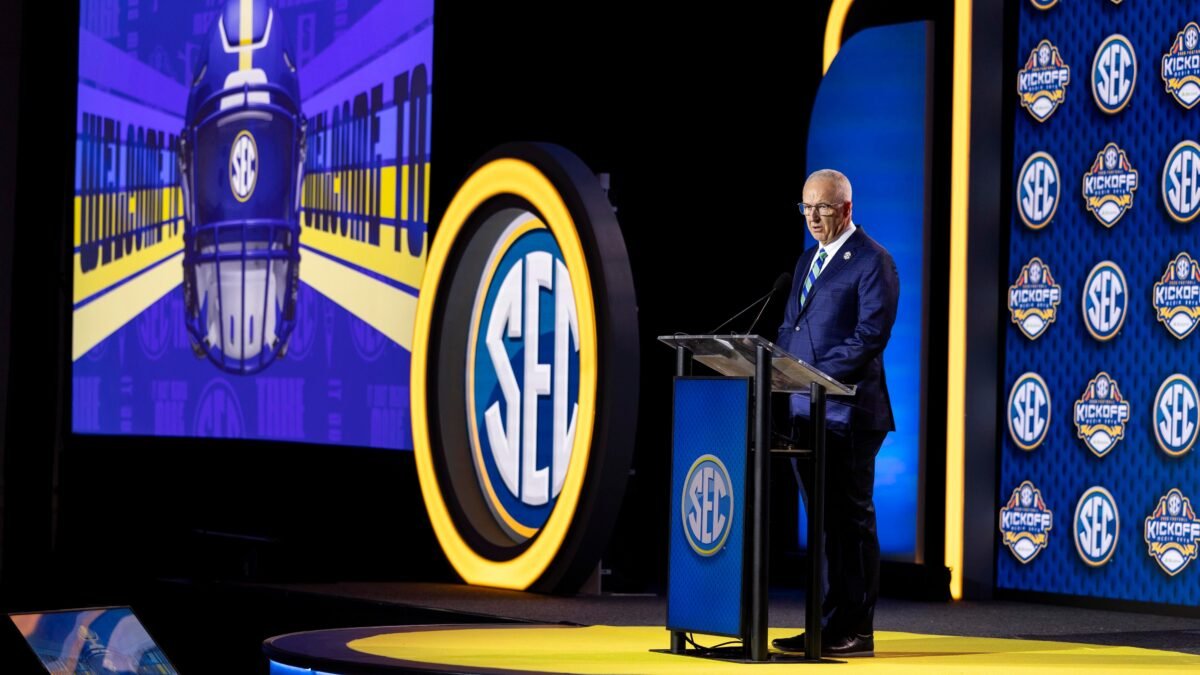
The SEC and Big Ten conferences are pushing for a higher salary cap, with the SEC Commissioner Greg Sankey stating that the current cap is too low.
The Protect College Sports Act is still being negotiated in Congress, with the conferences seeking answers on whether an increase in revenue share would impact rules governing third-party payments to players. The current revenue-sharing "salary cap" is set at $21.3 million for this school year.
A pair of documents outlining concessions the lawmakers have made in the negotiations revealed a $20 million-plus "retention pool" that schools could use to keep players from leaving. This would effectively double the revenue-sharing cap.
The conferences are seeking clarity on how the increased revenue share would impact the House settlement, a $2.8 billion lawsuit settlement that dictates rules around revenue sharing. Jeffrey Kessler, the plaintiffs' attorney, has said he would need to see the language before weighing in on whether it impacts the settlement.
The SEC and Big Ten have put out a paper outlining 10 "Common Sense Improvements" for the PCSA, with the first two entries dealing with antitrust protection and preemption of state laws. However, these issues were absent from the documents outlining concessions.
Ohio State athletic director Ross Bjork expressed confusion over what would happen if the university went over the revenue-sharing cap by $2 million. "We haven't gotten any clarity on that," he said. "Does it go to some local federal prosecutor? We don't know."
The current cap of $21.3 million is already being ignored by some schools, with Stewart Mandel noting that any cap agreed to will be immediately ignored by some. The same people who spent years begging for "guardrails" blew right through them, with top-end rosters going from $20 million to $30 million last year to $40 million to $50 million this year.
Ohio State coach Ryan Day expressed his support for a higher cap, saying, "Do I think the cap should be higher? Absolutely." Rich Eisen has suggested that the super league is coming, with Jeremiah Smith's recruitment by Alabama being a prime example.
Smith's early commitment to Ohio State may have been a reason for Saban to back off, with Smith noting, "I think I committed to Ohio State too early. That's why they stopped. They thought there was no chance."
Damien Harris thinks Alabama's running backs need an attitude adjustment, saying, "For the backs, this is a mentality thing… It's similar to offensive line, it's similar to defensive line, linebacker. You have to play, you have to be nasty to play this position."
Alabama will face Florida State in their biggest nonconference opponent of the season on September 19. The game marks the Seminoles' first visit to Bryant-Denny Stadium since 1974.
The Protect College Sports Act negotiations are ongoing, with the outcome uncertain. If the revenue-sharing cap is increased, it will be interesting to see how the House settlement is impacted. The conferences are seeking clarity on the rules governing third-party payments to players, and the outcome will have significant implications for the future of college sports.
Source: Yahoo Sports