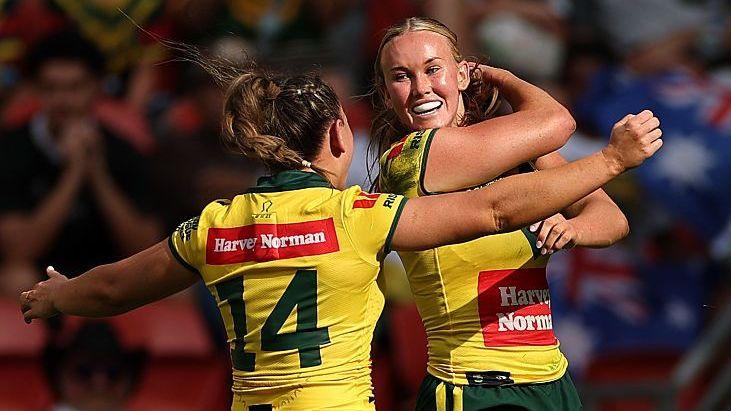
Jaime Chapman’s acrobatic second try in the corner put the Women’s Rugby League World Cup final beyond doubt inside 15 minutes, setting the tone for Australia’s emphatic 34-10 victory over New Zealand in Brisbane. Chapman scored a hat-trick in the opening half as the Jillaroos surged to a commanding lead, sealing a record fourth consecutive World Cup title.
Australia dominated the first 35 minutes, running in six tries to New Zealand’s one during a blistering opening half marked by a succession of errors and ill-discipline from the Kiwi Ferns. Chapman’s three tries, combined with efforts from Shaylee Bent, Jess Sergis, Tamika Upton, and Abbi Church, helped Australia build a 24-point lead before New Zealand scored their only first-half try through Shannon Mato.
The match was played under tough conditions, which required drinks breaks in each half and a longer halftime interval. Despite this, Australia appeared unaffected and capitalised on the poor New Zealand defence and handling errors. The Jillaroos’ initial burst included Chapman overpowering three defenders to open scoring just over two minutes in, followed by Bent slicing through New Zealand’s defence for Australia’s second try.
Jess Sergis went the length of the field for the fourth try, although replays suggested a suspected forward pass in the build-up. New Zealand’s Mato crossed soon after to provide a brief reprieve, but Chapman’s 60-metre sprint to complete her hat-trick left the Kiwi defence grasping at shadows. Later, slick passing allowed Upton to score under the posts, with Jesse Southwell converting five of six attempts, including two from the left touchline.
Chapman, who faced a spinal fracture in February 2025 and recent media scrutiny, was named player of the match for her performance. She ran 151 metres, broke the line three times, completed seven tackle busts, and even made a try-saving tackle. Captain Isabelle Kelly praised Chapman’s finishing ability and resilience, saying, “She’s had a lot of stuff going on the last few years and she’s really stepped up and owned that position.”
Australia’s dominance extended into the record books, with the team now unbeaten in 16 World Cup matches since July 2013. They have scored 306 points while conceding just 30 across the tournament. The Jillaroos’ record fourth consecutive World Cup title broke new ground in women’s rugby league.
The second half saw a shift in momentum. Australia eased off, managing only one notable scoring opportunity through Tarryn Aiken, whose try was denied by a try-saving tackle from Georgia Hale. New Zealand improved their defence and scored a consolation try through Mackenzie Wiki in the 70th minute, but persistent handling errors and loose passing hampered their attack. They completed just over half of their sets and struggled to supply stand-off Chantay Kiria-Ratu effectively.
New Zealand head coach Ricky Henry said the game was “a game of two halves,” expressing frustration that his side failed to handle the pace early on. “They got on top and from there, we couldn’t regroup and get our rhythm,” he added.
Australia’s head coach Jess Skinner’s choice of Southwell over Jocelyn Kelleher at stand-off proved a tactical success. Southwell’s composure with conversions helped maintain the scoreboard pressure. Despite a suspected forward pass on Sergis’s long try, the Jillaroos’ overall execution left New Zealand chasing shadows.
Chapman’s performance was the standout of the tournament. Her tries displayed a mix of power, pace, and athleticism, from overpowering defenders to a spectacular cartwheel dive and a blistering sprint. With 13 tries in the tournament, she led the scoring charts and established herself as a world-class athlete and a marketable figure in the sport.
The final settled quickly and decisively in Brisbane, confirming Australia’s status as the dominant force in women’s rugby league for the foreseeable future.
According to Yahoo Sports.