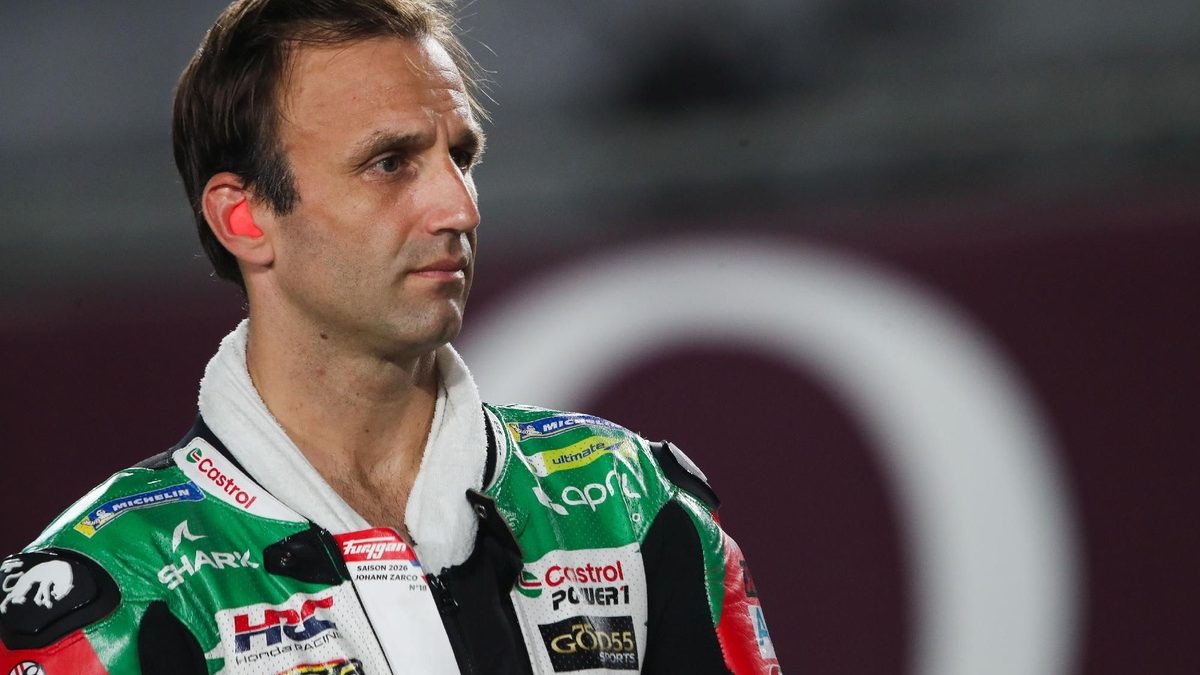
Johann Zarco’s recovery from a double accident at the Catalan Grand Prix this May took a decisive turn during the Qatar Grand Prix, where a red flag incident unexpectedly helped him regain confidence on the track. The French rider credits the restart in Lusail for overcoming mental barriers left by his crash in Barcelona, where a severe knee injury threatened his racing future.
The Barcelona incident unfolded on lap 11 when Pedro Acosta’s KTM stopped while leading. Alex Marquez crashed into Acosta’s bike, sending his Ducati airborne and scattering debris. Zarco, following closely, was struck in the foot by one of the fragments. Despite intense pain, he returned to racing after the red flag but soon after suffered a horrific crash in the first corner of the restart. His leg was caught in the rear wheel of Francesco Bagnaia’s Ducati and bent unnaturally.
Zarco was rushed to hospital, but swelling around his knee delayed surgery. Doctors struggled to assess the full extent of ligament and tendon damage. A deep burn further complicated treatment, making surgery too risky due to infection concerns. The LCR Honda rider sought out Dr Bertrand Sonnery-Cottet in Lyon for specialised care. He missed six rounds before returning at Aragon in late August, managing a partial recovery without surgery.
His best performance since then came in Qatar, where he scored 12 points, his highest haul of the season. Zarco had not faced a similar red flag and restart scenario since Barcelona, until the Lusail race. After qualifying seventh, he made a strong start but was caught in a second group behind Bagnaia, who crashed heavily, triggering another red flag.
Zarco said the red flag brought back memories of his Barcelona crash. “Honestly, when the race was stopped, what happened in Catalunya came back into my mind,” he said after the sprint in Lusail. “But it was a different situation because this time I was not involved in the accident. That’s why I was able to maintain my concentration.”
At the second start, Zarco gained two positions and battled with Pedro Acosta and Raul Fernandez, eventually finishing fifth – his best result this year. He described the experience as a breakthrough after the trauma in Spain, where pain and adrenaline drops impacted his focus. “In Qatar, on the other hand, I was there, ready to compete again, prepared and focused,” he added.
Zarco’s determination helped him overcome the psychological scars from the Barcelona crash. “It was very positive to achieve an excellent second start like the one we made. It was the best way to overcome it,” he said. “What happened in Catalunya is now in the past, but Qatar served to definitively leave that memory behind.”
The Barcelona crash left Zarco facing uncertainty over his racing career. The injury to his knee ligaments and tendons was severe, complicated by swelling and a burn sustained during the accident. Recovery without surgery was unexpected, and his gradual return to competitive form has been closely watched. Since his return, Zarco has shown resilience, though the Qatar race remains the standout after the incident.
The incident also involved other riders. Alex Marquez was unable to avoid Acosta’s stopped bike, leading to the initial crash. Francesco Bagnaia’s heavy crash caused the second red flag in Qatar, but unlike in Barcelona, Zarco was not involved and was able to focus on the restart.
Zarco’s progress will be closely observed as MotoGP continues its demanding schedule. His experience in Qatar suggests he can still compete at a high level despite the setbacks earlier this year. The red flag in Lusail unexpectedly became a moment of clarity and recovery for the French rider, allowing him to put a difficult chapter behind him.
According to Yahoo Sports.