
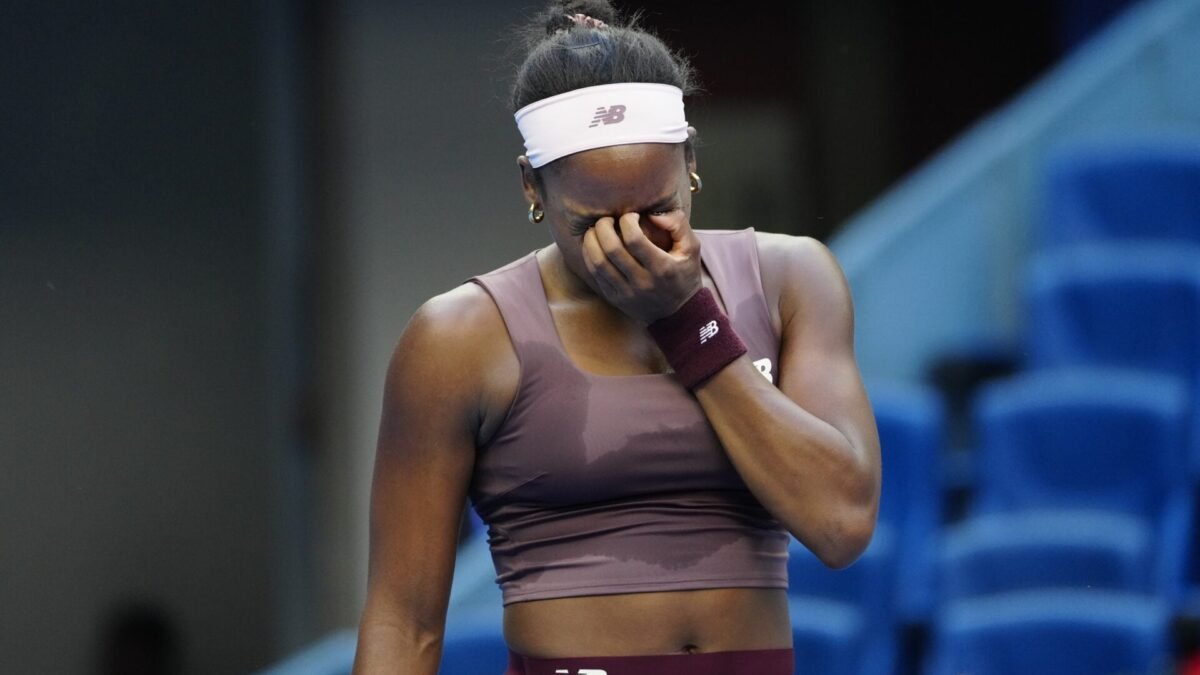
Coco Gauff’s China Open campaign ended abruptly in the Round of 16 when she lost to Elise Mertens after visibly struggling on court. The 23-year-old American appeared exhausted during the match, telling her coaching box, “I have no energy. I’m trying, I have no energy. I can’t see the ball; I feel like I’m going to pass out. I’m going to just try to finish the match,” according to James Hansen of The Athletic. Four games later, she was out of the tournament.
Gauff’s defeat was one of several high-profile exits at the WTA 1000 event in Beijing, where early losses from top seeds have opened the draw. Though she had only played three matches, the tournament took a visible toll on her. The elongated format of these WTA 1000 events has drawn criticism from players and fans alike for adding strain to an already demanding schedule. Gauff also endured a difficult moment earlier in the event after beating 16-year-old Chinese player Sun Xinran, who faced accusations of cheating that created an unsettling atmosphere.
After the loss to Mertens, Gauff spoke briefly about her performance, offering a succinct assessment without elaboration. The physical or mental fatigue behind her mid-match plea remains unclear.
Following her exit, Gauff withdrew from the upcoming Wuhan Open, citing exhaustion. Her decision adds to a growing list of withdrawals that have weakened the field for the tournament. Naomi Osaka, another notable player, was eliminated in Beijing by Karolina Muchova in a three-set match. The biggest blow to the Wuhan Open’s draw came with the withdrawal of world number one Elena Rybakina due to injury.
Other players including Amanda Anisimova, Emma Navarro, and Anastasia Potapova have ended their 2026 seasons early and will also miss the Wuhan event. Organisers now face a depleted roster as several top competitors step away from the Asian swing, leaving room for less experienced players to make deeper runs.
According to Yahoo Sports.