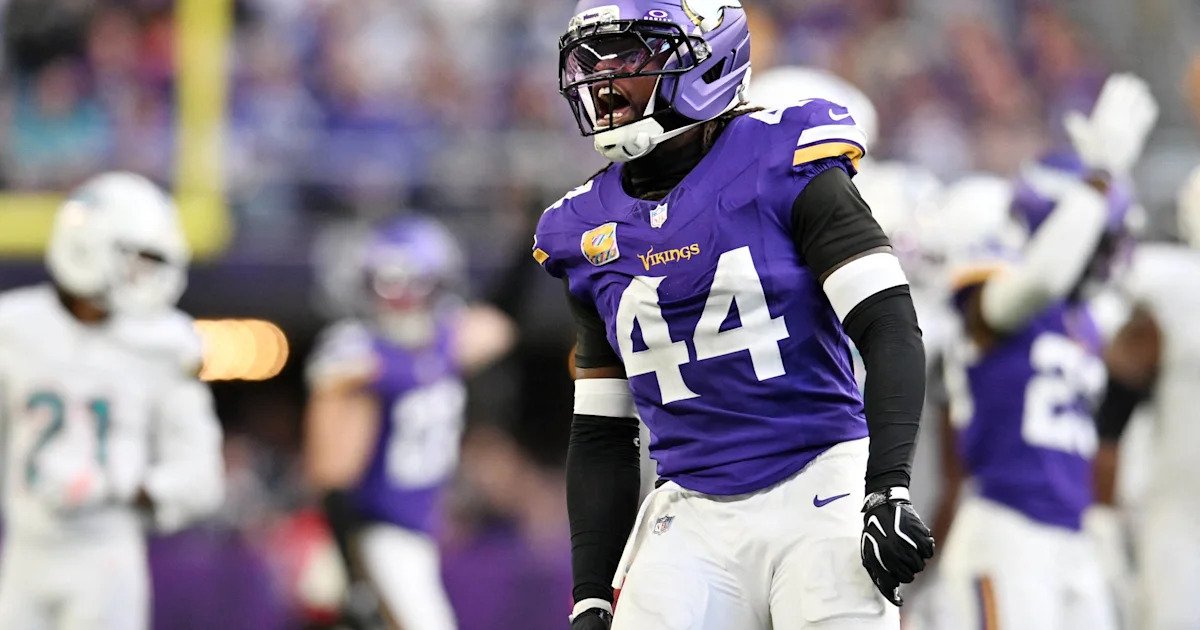
The Minnesota Vikings’ defense has allowed just 12.8 points per game through four weeks of the 2026 NFL season, matching early numbers posted by two of the most celebrated defensive units in recent history: the 2000 Baltimore Ravens and the 2002 Tampa Bay Buccaneers. With a perfect 4-0 start, the Vikings’ defensive stats invite comparisons to the Ravens and Buccaneers, both of which went on to win Super Bowls behind their dominant defense.
Through four games, the Vikings have held opponents to 12.8 points per game, slightly better than the Ravens’ 13.7 and close to the Buccaneers’ 11.7. The Vikings have forced seven turnovers, trailing only the Buccaneers’ eight and the Ravens’ ten forced turnovers in their early season stretches. Opposing quarterbacks have completed 51.1 percent of their passes against Minnesota, throwing for 881 yards with three touchdowns, four interceptions, and enduring 16 sacks. This compares favorably with the 2002 Buccaneers, whose opponents completed 51.9 percent with 819 yards, two touchdowns, seven interceptions, and 13 sacks, and the 2000 Ravens, who allowed a 55 percent completion rate, 850 yards, four touchdowns, five interceptions, and 10 sacks.
The Vikings have faced a tougher slate of quarterbacks than their historic predecessors. Their opponents include Jordan Love, Caleb Williams, Baker Mayfield, and Malik Willis. Meanwhile, the Buccaneers faced two solid starters in Aaron Brooks and Kurt Warner, alongside backups Chris Redman and Akili Smith. The Ravens’ early-season opponents included Kent Graham, Mark Brunell, Jay Fiedler, and Scott Mitchell, many of whom were past their prime or inexperienced starters.
Minnesota’s run defense has allowed 378 yards on 91 carries, averaging 4.15 yards per carry. This is a less stout figure than the Ravens, who yielded just 186 yards on 89 carries (2.09 yards per carry), and the Buccaneers, who allowed 336 yards on 103 carries (3.26 yards per carry). The Vikings have been more effective on third down, limiting opponents to conversions on just 22.6 percent of third-down attempts, compared to 32.3 percent for Tampa Bay and 31.4 percent for Baltimore in their respective early seasons.
On a per-play basis, however, the Vikings concede 4.86 yards, higher than the Buccaneers’ 3.89 and the Ravens’ 4.36. This suggests that while the Vikings excel at limiting scoring and third-down success, there is room for improvement in overall yardage defense.
The 2000 Ravens set records for points allowed per game (10.3) and total rushing yards allowed (970) in the 16-game regular season era, finishing with 49 forced turnovers. The 2002 Buccaneers were known for a pass defense that allowed just 155.6 yards per game and 10 passing touchdowns all season, intercepting 31 passes and scoring four defensive touchdowns in the playoffs, including three pick-sixes in the Super Bowl against the Raiders.
Brian Flores, the Vikings’ defensive coordinator, has crafted a unit that through four games is statistically comparable with these historic defenses in key areas such as points allowed, forced turnovers, and opponent quarterback performance. The Vikings’ 4-0 record reflects this defensive strength, even as questions remain about sustaining this level across the full season.
The Vikings’ early-season performance raises interest in how far this defense can go, though four games remain too few to label any unit legendary. For now, Minnesota is outperforming expectations and setting a defensive standard that recalls some of the greatest NFL defenses of the past quarter-century.
According to Yahoo Sports.